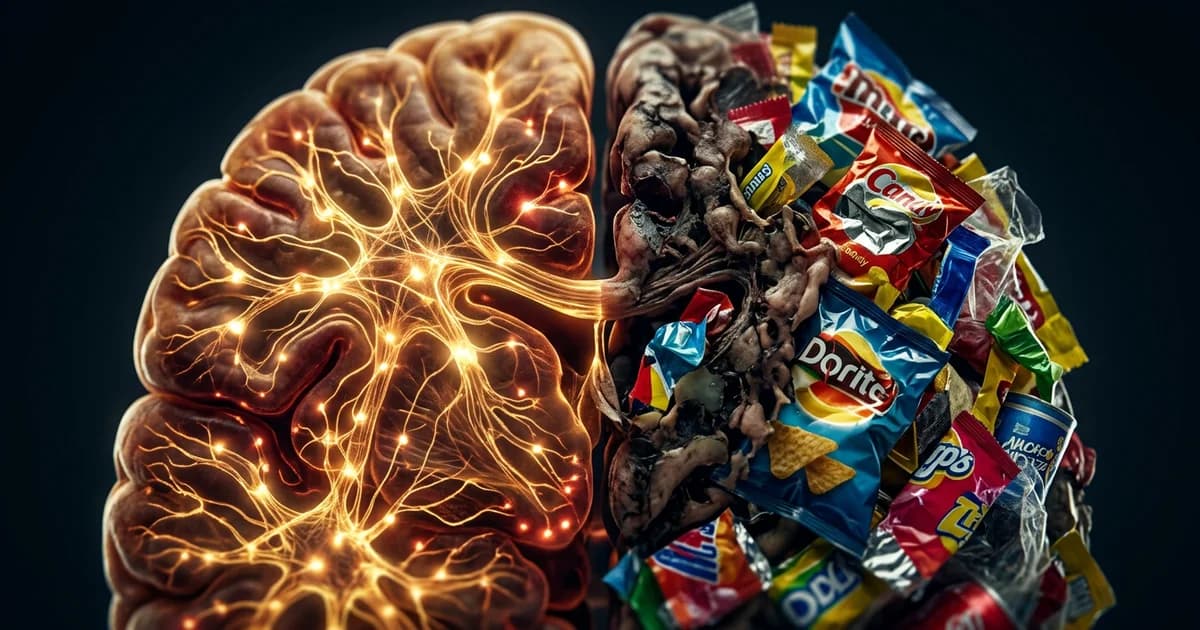
73% of your groceries are rewiring your brain like a drug

The grocery aisle is not what you think it is
Walk into any American supermarket and 73% of the products on the shelves share one thing in common: they have been engineered in a lab to make you eat more. Not seasoned, not prepared. Engineered, the way a pharmaceutical company engineers a compound to cross the blood-brain barrier and trigger a specific receptor.
A landmark study published in JAMA Neurology tracked 10,775 adults over eight years and found that people who got more than 20% of their daily calories from ultra-processed food experienced cognitive decline 28% faster than those who ate the least. Executive function, the mental machinery behind planning, focus, and self-control, declined 25% faster.
The threshold was not extreme. It was not junk food addicts versus health purists. The damage appeared above the lowest quartile of consumption, meaning that most people reading this sentence are already above it.
Your brain on ultra-processed food
The mechanism is not subtle. A 2025 UK Biobank study scanned the brains of 33,654 people and found that higher ultra-processed food intake physically altered the structure of the nucleus accumbens (the brain's reward processing center). Cell density dropped. Extracellular space expanded. These are textbook markers of neurodegeneration, the same patterns seen in the early stages of Alzheimer's.
The pathway runs through inflammation. Higher ultra-processed food consumption raised blood levels of C-reactive protein (CRP), a marker your doctor checks when looking for chronic inflammation. That elevated CRP, in turn, predicted structural damage to the nucleus accumbens. Your body's immune system is literally attacking your brain's reward circuits because of what you ate for lunch.
This creates a self-reinforcing trap. Damaged reward circuits make you crave more of the food that damaged them. Your pallidum and putamen, brain regions that govern habitual behavior, show the same reduced cellularity. The more you eat, the harder it becomes to stop, not because you lack willpower, but because the hardware responsible for self-regulation is being physically degraded.
The addiction nobody diagnoses
This is not a metaphor. A systematic review of 281 studies across 36 countries found that 14% of adults and 15% of children now meet the clinical criteria for ultra-processed food addiction. Among people with obesity, the rate jumps to 28%.
The criteria are the same ones used for substance use disorders: compulsive consumption despite negative consequences, withdrawal symptoms, escalating intake to achieve the same satisfaction. Ultra-processed foods trigger upregulation of calcium-permeable AMPA receptors in the nucleus accumbens, the exact neurochemical signature of addictive substances. People with ultra-processed food addiction show enhanced functional connectivity across reward processing regions identical to patterns found in cocaine and alcohol dependence.
Yet no diagnostic manual recognizes this condition. No doctor screens for it. And 73% of what your grocery store sells falls into the ultra-processed category under the NOVA classification system, the framework developed by researchers at the University of Sao Paulo that the UN now uses as a reference.
The 20% threshold your doctor never mentions
The ELSA-Brasil cohort did not study people eating fast food three times a day. The participants who showed accelerated cognitive decline were getting roughly 20% of their calories from ultra-processed sources. For context, the average American gets 55% to 60% of daily calories from ultra-processed food. The average child gets over 60%.
This means most people in industrialized countries are not just above the damage threshold. They are two to three times beyond it.
The cognitive effects compound over time. The eight-year follow-up showed that the gap between high and low ultra-processed food consumers widened as the study progressed. This is not a stable disadvantage. It is an accelerating one. Every year of high consumption adds to the cumulative structural damage in feeding-related brain regions, including the hypothalamus, amygdala, and thalamus.
What the food industry already knows
Ultra-processed foods are 52% cheaper than minimally processed alternatives. They are designed with specific fat-to-sugar ratios that maximize dopaminergic firing in the brain (the circuits that drive motivation and reward), combinations that do not exist in nature. No whole food delivers the simultaneous sugar, fat, and salt payload of a flavored yogurt or a frozen pizza.
The adolescent brain is especially vulnerable. Reward centers become hyperresponsive during teenage development, characterized by heightened activation and increased sensitivity to rewarding cues. A 15-year-old eating the standard Western diet is not just consuming calories. They are training their gut-brain connection to prioritize engineered food over real food during the exact developmental window when neural circuits are being permanently wired.
The uncomfortable math
Countries that have acted on this data are seeing results. Mexico mandated front-of-pack warning labels and saw a measurable decline in ultra-processed food purchases. France created both the NOVA classification framework and the Nutri-Score labeling system.
But the structural problem remains. Redesigning your environment matters more than willpower here, because willpower is processed by the same prefrontal circuits that ultra-processed food degrades. The nucleus accumbens damage is not theoretical. It shows up on brain scans.
The first step is not a diet overhaul. It is checking how much of your daily intake falls into the NOVA Group 4 category: products made entirely or mostly from substances derived from foods, with little or no intact Group 1 food. If what you cook with matters too, what you open from a package matters far more.
Twenty percent. That is where the damage starts. And the average person passed that line years ago.
Sources and References
- JAMA Neurology / ELSA-Brasil — 10,775 adults tracked over 8 years showed 28% faster global cognitive decline.
- Nutrients (PMC) / Systematic Review — 281 studies across 36 countries found 14% of adults and 15% of children meet UPF addiction criteria.
- npj Metabolic Health and Disease / UK Biobank — 33,654 UK Biobank brain scans showed UPF reduces cellularity in nucleus accumbens via CRP.
- BMJ / Umbrella Review — Umbrella review: 25-35% excess dementia risk in highest UPF consumption quintile.
Read about our editorial standards →