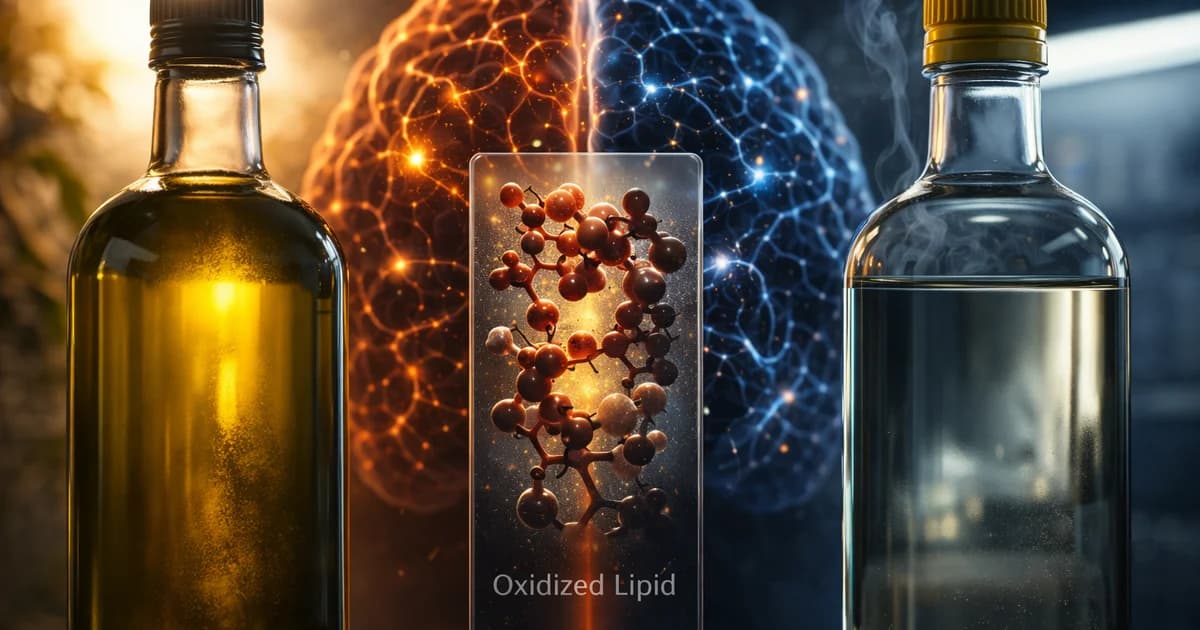
Seed oils vs olive oil: the oxidation science your kitchen ignores

Seed oils are toxic. Olive oil is the only safe option. If you spend any time on social media, you have probably seen both claims repeated with absolute certainty, usually accompanied by grainy diagrams of molecular structures and a tone of barely contained panic.
Here is what neither camp mentions: a 2024 review in the journal Lipids in Health and Disease found that a 5% increase in energy from polyunsaturated fats (the kind concentrated in seed oils) was associated with a 7% reduction in cardiovascular mortality. Not an increase. A decrease. The same review confirmed that higher intake of linoleic acid, the omega-6 fatty acid critics love to blame for inflammation, produced no measurable rise in inflammatory markers like TNF-alpha, interleukin-6, or C-reactive protein.
So seed oils are perfectly fine? Not so fast.
The real villain lives in your kitchen, not in the bottle
The safety of any cooking oil depends less on which oil you buy and more on what happens after you open it. A study published in Toxicology Reports found that rats consuming oil that had been heated three times showed cholesterol levels of 250 mg/dL compared to 143 mg/dL in controls, nearly double. Their liver tissue showed fat accumulation and cellular damage. Their colons developed adenomatous polyps, precancerous growths, after prolonged exposure.
The peroxide value of that reheated oil reached 34 mEqO2/kg, more than three times the 10 mEqO2/kg safety limit for edible oil. The oil in question was not some exotic industrial product. It was ordinary vegetable oil, heated and reused the way millions of households and restaurants do every day.
What heating actually does to oil molecules
When any cooking oil reaches high temperatures, its fatty acid chains break apart. The fragments that form are called aldehydes, and a 2025 review in Food Chemistry: X identified six particularly dangerous ones: acrolein, formaldehyde, acetaldehyde, and three compounds collectively linked to DNA fragmentation, enzyme dysfunction, and activation of inflammatory pathways that accelerate cellular aging.
The critical factor is not the oil type alone. It is the ratio of polyunsaturated fatty acids (PUFAs, meaning fats with multiple weak points in their molecular chains) to monounsaturated fatty acids (MUFAs, fats with only one). PUFA-rich oils, including soybean, sunflower, and corn oil, have more molecular weak points where heat can trigger breakdown. MUFA-rich oils like olive and avocado oil resist this process more effectively.
Research published in Scientific Reports confirmed that residual aldehyde concentrations in heated PUFA-rich oils consistently exceeded those in MUFA-rich alternatives like olive and canola oil, regardless of temperature. The difference was not marginal.
Why olive oil is not automatically the winner
Extra virgin olive oil does carry a genuine advantage: polyphenols. These natural antioxidant compounds slow oxidation and have been shown to extend the usable life of oil under frying conditions, with EVOO lasting 24 to 27 hours of continuous frying versus 15 hours for a standard vegetable oil blend.
But that protection only works under specific conditions. Store olive oil next to your stove, exposed to heat and light, and those polyphenols degrade rapidly. Use it past its best-by date, and its oxidative stability drops to levels comparable to the seed oils it supposedly outclasses. Pour it into a clear glass bottle on a sunny countertop, and you are essentially accelerating the same breakdown process you were trying to avoid.
Meanwhile, a properly stored, fresh bottle of high-oleic sunflower oil (a seed oil bred to contain more MUFAs) can outperform a degraded bottle of olive oil on every oxidation metric.
What actually matters: three rules that override the oil debate
The science points to storage and handling as the primary determinants of oil safety, not the label on the bottle.
- Keep oil in dark, cool storage. Light and heat trigger oxidation before you even turn on the stove. A dark cabinet away from the oven is non-negotiable.
- Never reheat oil more than once. Each heating cycle multiplies aldehyde production and pushes peroxide values toward dangerous thresholds. That pot of oil you reuse for weekly frying is quietly becoming more toxic with every round.
- Match the oil to the cooking method. Use MUFA-rich oils (olive, avocado) for high-heat cooking. Reserve PUFA-rich oils (flaxseed, walnut) for dressings and low-temperature applications where their nutritional benefits remain intact.
The real scandal is not that seed oils exist or that olive oil is overpriced. It is that the storage and handling practices in most kitchens turn perfectly safe oils into sources of compounds linked to liver damage, chronic inflammation, and precancerous changes. The bottle matters far less than what you do with it after you bring it home.
Sources and References
- Lipids in Health and Disease (PMC) — A 5% increase in energy from polyunsaturated fats was associated with a 7% reduction in cardiovascular mortality. Higher linoleic acid intake produced no measurable rise in inflammatory markers (TNF-alpha, IL-6, CRP).
- Toxicology Reports (PMC) — Rats consuming thrice-heated vegetable oil showed cholesterol of 250 mg/dL vs 143 mg/dL in controls. Peroxide values reached 34 mEqO2/kg (3.4x the 10 mEqO2/kg safety limit). Colon adenomatous polyps developed after prolonged exposure.
- Food Chemistry: X (PubMed) — Six primary toxic aldehydes (acrolein, formaldehyde, acetaldehyde, t,t-2,4-DDE, 4-HHE, 4-HNE) form during high-temperature cooking, causing DNA fragmentation, enzyme dysfunction, and pro-inflammatory pathway activation.
- Scientific Reports (Nature) — Residual aldehyde concentrations in heated PUFA-rich oils consistently exceeded those in MUFA-rich alternatives like olive and canola oil, regardless of temperature.
- Food Chemistry (ScienceDirect) — Extra virgin olive oil lasted 24-27 hours of continuous frying vs 15 hours for standard vegetable oil blends, due to superior polyphenol content providing oxidative protection.
Read about our editorial standards →