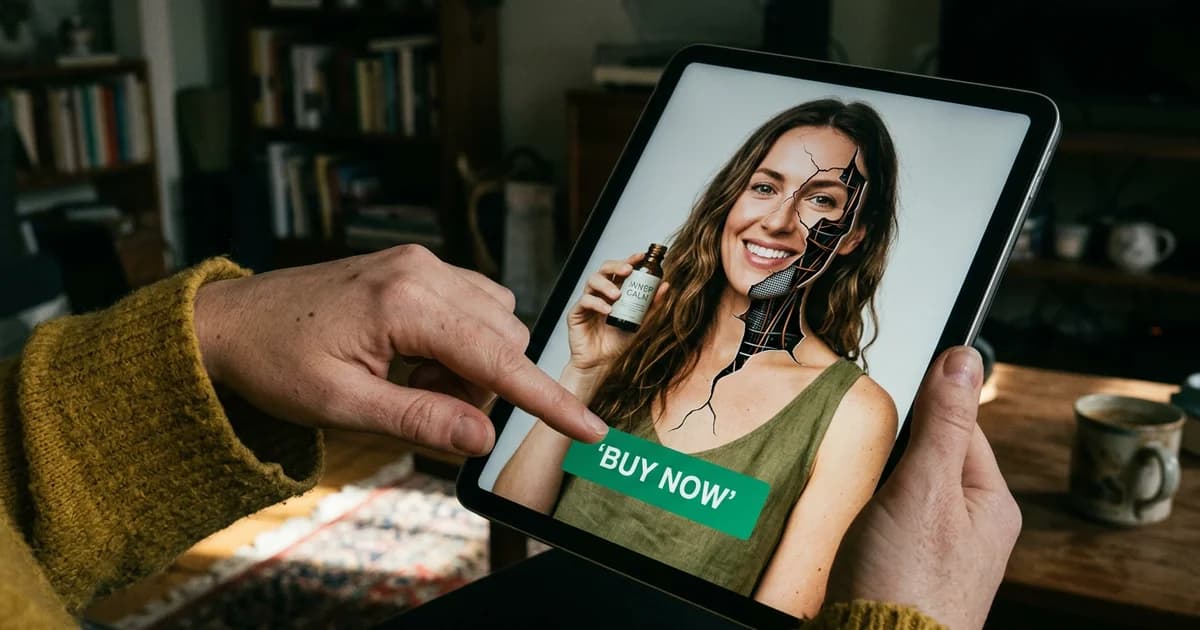
Why AI Influencers Destroy Trust in Wellness Marketing

A perfectly rendered digital face tells you a new supplement transformed her energy, sleep, and skin. She shares a 'personal journey' of overcoming fatigue with a green powder. The story is compelling, the visuals flawless. But she has no skin, never slept poorly, and cannot experience fatigue. She is a synthetic influencer, and her most dangerous sales pitch is happening in the one category where trust is the entire product: wellness.
Why this matters now
This isn't a fringe trend. Major brands are experimenting with AI avatars to promote supplements, skincare, and fitness programs. The logic seems sound: cost-effective, scalable, and always on-brand. Yet, a 2026 study in the Journal of Retailing and Consumer Services reveals a critical flaw. The research found that perceived mental humanlikeness directly affects consumer trust and relationship responses. When an entity lacks true human experience, the bond is transactional and fragile [1]. In wellness, where results are subjective and deeply personal, that fragile bond breaks.
The problem is not that AI influencers exist; it's what they're being asked to sell. TIME reported that most enterprise marketers still do not plan to use AI avatars in 2026, citing an authenticity problem with non-human endorsements [2]. This caution is wise, but it's being ignored in the fast-moving wellness space, where new brands seek quick credibility. An AI influencer can claim a product 'changed my life,' but the statement is a hollow script. It lacks the nuance, the setbacks, the tangible proof of lived experience that a human testimonial provides, even if that human testimonial is imperfect.
Reporting from The Atlantic on 'fake' influencers describes this precise scenario: synthetic avatars selling real products, often in wellness categories where lived experience matters [3]. The avatar becomes a vessel for a brand's message, but it cannot be a vessel for truth. Consumers, especially those investing in their health and identity, seek alignment with a person's journey. They want to trust that the endorser has navigated the same challenges. An AI has navigated nothing. Its 'journey' is a narrative algorithm, optimized for conversion, not connection.
What changes in practice
This creates a profound dissonance. The marketing invokes deep identity triggers: promises of better health, vitality, self-improvement: but the messenger has no identity. It's a pattern interrupt for the consumer's subconscious evaluation process. We instinctively weigh testimonials based on perceived authenticity. A synthetic face, no matter how 'humanlike,' fails this test when the product category is intrinsically human. The result is a hidden erosion of brand trust. A consumer might buy once, but the lack of authentic endorsement leaves no foundation for loyalty. When the product's effects are subtle or require long-term use (as many wellness products do), that missing foundation causes churn.
Furthermore, this approach misunderstands why influencer marketing works in wellness. It's not just about reach; it's about relational proof. A human influencer's imperfect skin, their real fatigue, their documented progress: these are trust signals. An AI influencer's perfection is a trust anti-signal. It whispers that the story is manufactured, which implies the results might be, too. This taps into a powerful consumer psychology hook: loss aversion. People are more motivated to avoid a loss (of money, time, health) than to gain a benefit. An inauthentic endorsement triggers suspicion of loss: the fear that the product won't work as promised because the promoter couldn't possibly know.
The contrarian take is this: AI influencers are least suitable for authenticity-dependent categories, not most. Their strength is in promoting unambiguous, functional goods where the claim is objective (e.g., 'this phone has a 48MP camera'). Wellness is the opposite. Every claim is subjective and experience-based. Using a synthetic entity here is a category mismatch that risks the brand's core asset: trust.
This authenticity deficit isn't isolated. As we've explored, AI content is losing the authenticity test across digital media. And in direct conversion, AI scarcity copy is converting 41% worse than human-written, underscoring that algorithmic persuasion falters when emotional, human stakes are high. The wellness aisle is the highest-stakes aisle.
The path forward isn't to abandon AI in marketing, but to apply it with category awareness. For wellness brands, the investment must remain in human stories, even if those stories are less scalable. For AI influencers, their domain should be categories where the product's value is externally verifiable and the 'experience' of use is secondary. Selling trust requires a trustee who has something to lose. A synthetic influencer, by definition, has nothing to lose. In wellness, that's a deal-breaker.
Sources and References
- Journal of Retailing and Consumer Services — A 2026 study on AI influencers finds that perceived mental humanlikeness affects trust and relationship responses among consumers.
- TIME — TIME reported that most enterprise marketers still do not plan to use AI avatars in 2026, partly because non-human endorsements carry an authenticity problem.
- The Atlantic — Reporting on fake influencers describes synthetic avatars selling real products, often in wellness categories where lived experience matters.
Read about our editorial standards →