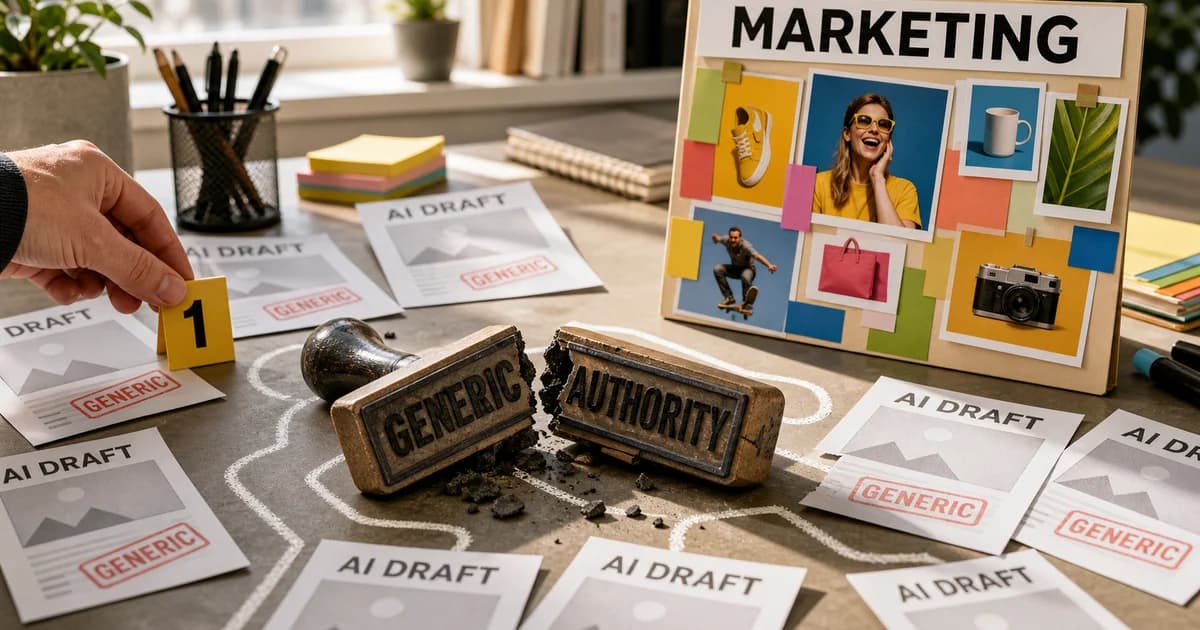
AI Didn't Kill Marketing. It Killed Generic Authority.

A common narrative has taken hold in marketing circles: AI is killing content. The flood of machine-generated text, images, and videos is supposedly drowning out human creativity and devaluing the written word. But this diagnosis misses the real patient. The problem isn't the tool; it's the symptom it amplifies. AI didn't kill marketing; it exposed and accelerated the death of generic authority.
Why this matters now
For years, brands could get away with sounding interchangeable. Marketing copy was often a game of safe clichés, corporate jargon, and platitudes designed to offend no one and inspire nothing. This created a vacuum of genuine perspective, a bland landscape where brands competed on volume and distribution, not distinct voice or valuable insight. Then, AI arrived as the ultimate generic content machine. It excels at producing text that is structurally correct, grammatically flawless, and utterly devoid of a unique point of view.
This is where consumer perception has shifted decisively. A pivotal Gartner survey in March 2026 revealed that 50% of consumers now prefer brands that avoid using generative AI in consumer-facing content. This isn't a Luddite rejection of technology; it's a conscious punishment for sounding machine-made. Consumers are voting against interchangeability. They are using their attention and their wallets to reward the human, the specific, the authentic.
The data backs this up beyond sentiment. A rigorous 16-month Google ranking study by Digital Applied found that pure AI-generated content ranked lower, on average, than human-written articles. The researchers noted that "generic patterns and missing POV" were key factors hurting performance. Search engines, increasingly tuned to user satisfaction and expertise, are demoting content that lacks a distinctive, authoritative voice. It's not that AI can't be a part of the process, but when its output is indistinguishable from a thousand other brands, it fails the fundamental test of authority.
What changes in practice
This creates a fascinating paradox in modern marketing. Canva's 2026 Marketing AI Report highlights that 97% of marketing leaders use AI in their daily creative work. The tool is ubiquitous. Yet, the same report identifies "trust and originality" as the harder, more pressing problems. We've solved for scale and efficiency, but we've magnified the crisis of sameness. When everyone uses the same powerful tool with the same basic prompts, the output converges, not diverges.
The consequence is a new form of loss aversion for brands. The risk is no longer just being unseen; it's being actively dismissed as inauthentic. In a world saturated with competent but generic AI content, a brand that sounds like a committee-edited chatbot memo loses credibility. This is evident in sectors like wellness, where AI-generated influencers are eroding consumer trust by presenting a facade of authenticity without the substance of human experience.
So, what's the path forward? It requires a fundamental shift from content production to perspective cultivation. AI should be leveraged not as the writer, but as a research assistant, a first-draft generator, or an idea expander. The irreplaceable human role is to inject the unique perspective, the lived experience, the contrarian take, or the deeply specialized knowledge. It's about using the machine to handle the generic heavy lifting, freeing humans to do the uniquely human work of building a point of view.
This means embracing imperfection, specificity, and even controversy where appropriate. It means writing from a real place, with real observations, for a real audience. It means that a brand's content must pass the "So what?" test: if this article, social post, or video were stripped of the logo, would anyone know it came from you? Or could it have come from any of your competitors?
The brands that will thrive are those that understand AI didn't create the crisis of generic authority; it simply turned up the volume until it became unbearable. The solution isn't to abandon powerful tools, but to double down on the one thing they cannot replicate: your unique, human authority. As we've seen, content that lacks this authentic core is already failing the test in the eyes of both consumers and algorithms. The future belongs not to the brands that produce the most content, but to those that produce the most meaning.
Sources and References
- Gartner — Gartner reported in March 2026 that 50% of consumers prefer brands that avoid GenAI in consumer-facing content.
- Canva — Canva’s 2026 marketing AI report says 97% of marketing leaders use AI in daily creative work, while trust and originality have become the harder problem.
- Digital Applied — A 16-month ranking study reported pure AI content ranking lower on average than human-written articles, with generic patterns and missing POV hurting performance.
Read about our editorial standards →