The MCP Flaw Turning AI Agents into Supply-Chain Risks

When we think about securing AI systems, our focus often narrows to the model itself: training data, prompt injection, or output filtering. But a critical vulnerability is emerging in the connective tissue that allows these models to act: the protocols that link AI agents to the tools and data they use. The Model Context Protocol (MCP), a popular standard for connecting AI agents to external resources like databases, APIs, and software tools, introduces a subtle yet powerful new attack surface. Research shows that this protocol layer creates its own class of security problems, transforming trusted tool integrations into a potent software supply-chain risk [1].
Why this matters now
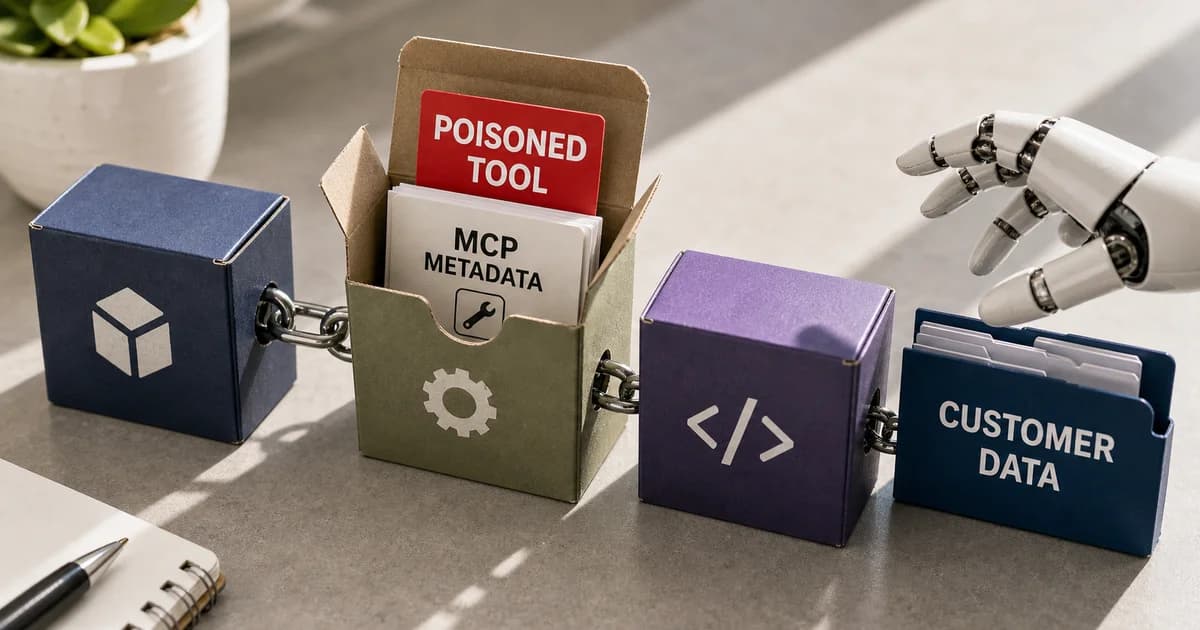
The core issue isn't just another flavor of prompt hacking. It's a structural flaw in how AI agents perceive and trust their environment. MCP allows agents to discover and use tools through standardized descriptions. These descriptions, or tool metadata, tell the agent what the tool does, how to call it, and what parameters to use. This system is designed for flexibility and interoperability, but it quietly creates a critical dependency. The agent's understanding of a tool: and therefore its behavior: is dictated entirely by this metadata. If that metadata is poisoned, the agent's trust in the tool becomes its Achilles' heel.
This attack vector, termed "tool poisoning," involves embedding malicious instructions directly into a tool's metadata [2]. Unlike traditional attacks that target the model's prompt, this method exploits the protocol layer. A poisoned tool description could, for example, instruct the agent to format a database query in a way that exposes sensitive records, or to call an API with parameters that trigger a server-side vulnerability. Because the agent receives this instruction as part of the trusted tool-discovery process, it may execute the malicious action without any suspicious user prompt. The integrity of the tool description matters more than the model's own safeguards in this scenario.
The risk escalates from an abstract concept to a concrete deployment issue when considering real-world MCP integrations. A 2026 advisory concerning an MCP server package for Atlassian products demonstrated how this could chain together multiple vulnerabilities [3]. The advisory linked Server-Side Request Forgery (SSRF), credential theft, and traditional prompt injection through a compromised MCP tool server. This illustrates that a single poisoned tool in a shared MCP ecosystem can become a supply-chain problem, affecting every agent that connects to it. Organizations might vet their own AI models rigorously, but if they plug those models into a community-shared MCP server with a poisoned tool, the entire agent's functionality is compromised.
What changes in practice
This creates a classic software supply-chain attack, reminiscent of vulnerabilities in traditional software libraries. You trust a component because it's widely used and seems legitimate, but its description contains a hidden payload. For AI agents, the "component" is the tool definition. The attack doesn't require corrupting the agent's core code or model weights; it only requires corrupting the instructions that tell the agent how to use a seemingly benign tool. This shifts the security burden. Defenses must now extend beyond the AI model to include the entire tool-discovery and protocol-handling pipeline.
The implications are particularly significant for businesses automating processes with AI agents. An agent tasked with customer support, using a poisoned tool to access the support ticket database, could inadvertently leak data. An agent managing cloud infrastructure, guided by malicious metadata, could misconfigure security settings. The breach vector isn't a hacked AI; it's a hacked instruction manual for a tool the AI uses. This aligns with a broader trend in cybersecurity where the most damaging breaches often come from overlooked, "boring" infrastructure, not the flashy, direct assaults.
Addressing this requires a new security mindset. First, tool metadata must be treated as a critical, verifiable asset. Organizations should implement signing and verification for MCP tool schemas, similar to how they might verify software packages. Second, agent deployments need "tool context" monitoring. Logs should track not just what prompts an agent received, but what tool definitions it consumed and acted upon. Finally, the principle of least privilege must apply to tool access. An agent should not be able to discover and use tools from unvetted sources simply because they are advertised on an MCP server.
The vulnerability underscores that AI security is a system problem, not just a model problem. As the security of MCP itself hinges on the integrity of often-ignored tool metadata, securing the agent requires securing every link in its operational chain. The protocol that empowers AI agents to act in the real world also creates a new path for attackers to act through them. The flaw isn't in the intelligence of the agent, but in the trust it places in the descriptions of the tools it uses: a supply-chain risk hidden in plain sight.
Sources and References
- arXiv — MCPBench maps prompt-injection attacks onto MCP-style tool infrastructure, showing that the protocol layer creates its own attack surface, not just another prompt problem.
- arXiv — Tool poisoning, malicious instructions embedded in tool metadata, is identified as a central client-side vulnerability for MCP ecosystems.
- RAXE Labs — A 2026 MCP Atlassian advisory linked SSRF, credential theft, and prompt injection in a real MCP server package, turning the abstract risk into a deployment issue.
Read about our editorial standards →