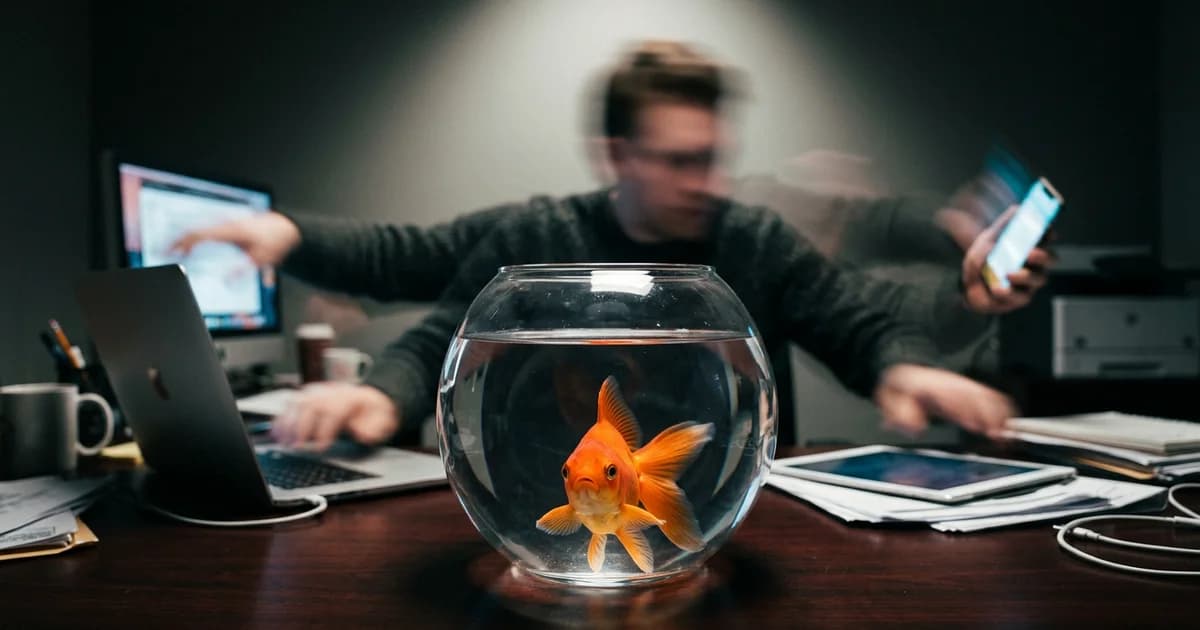
The 8-second attention span is a lie: what really happened to your focus

You have probably heard it: humans now have a shorter attention span than a goldfish. Eight seconds for us, nine for the fish. CEOs, TED speakers, and even Microsoft have cited it. There is just one problem: the entire statistic was made up.
In 2015, Microsoft Canada published a report claiming human attention spans had dropped from 12 seconds to 8 seconds since the year 2000. The figure went viral. But when BBC journalist Simon Maybin traced the claim to its source, he found it came from a website called Statistic Brain that had fabricated the data entirely. Not just the human number. The goldfish number too. Nobody has ever scientifically measured a goldfish’s attention span, and the sources Statistic Brain listed could not verify any of the figures.
The real numbers are worse than any goldfish comparison
Gloria Mark, Chancellor’s Professor of Informatics at UC Irvine, has spent over 20 years measuring how long people stay focused on screens. Her findings tell a far more specific story: in 2004, the average person spent 2.5 minutes on a single screen before switching. By 2012, that dropped to 75 seconds. By 2020, it was 47 seconds. The median sits at just 40 seconds, meaning half of all observations were even shorter.
That is not an “attention span.” That is a measurement of how quickly people switch between screens. The distinction matters enormously.
Why “attention span” is a meaningless metric
The concept of a single, universal attention span is itself flawed. As Neil Bradbury showed in a 2016 review in Advances in Physiology Education, the most frequently cited source for attention decline during lectures “barely discusses student attention at all.” The primary data do not support any fixed attention limit, whether 8 seconds or 15 minutes.
Your ability to focus depends on context: motivation, task difficulty, emotional state, and environment. You can binge-watch a series for six hours but struggle to read two paragraphs of a tax document. That is not a broken attention span. That is attention working as designed, prioritizing what feels rewarding.
This is the same mechanism behind why short-form video is shrinking your attention hardware. The issue is not capacity. It is what you are training your brain to expect.
The 25-minute tax you pay every time you switch
The real cost of fragmented attention is not the 47 seconds on each screen. It is what happens afterward. Mark’s research found that after any interruption, it takes an average of 25.5 minutes to fully return to the original task. And people self-interrupt more than they are interrupted by others.
You are not the victim of your phone’s notifications. You are the one reaching for it.
A 2024 editorial in Annals of Medicine and Surgery found that constant switching consumes up to 40% of productive time. Heavy digital multitaskers showed significantly greater anxiety and depression compared to lighter multitaskers. The problem is not that your brain cannot focus. It is that your environment never lets it.
This is why deep work is failing most knowledge workers. The strategy assumes sustained focus is the default. For most people, it has not been the default in years.
What is actually happening to your focus
Your brain has not degraded. It has adapted. It now expects rapid reward cycles: a new tab, a notification, a quick scroll. Gloria Mark calls this “kinetic attention,” a state of constant motion between stimuli. Your prefrontal cortex (the part responsible for planning and sustained attention) is not weaker. It is being asked to reconfigure itself hundreds of times per day.
This is also why cognitive overload is burning out top performers faster than anyone expected. The most engaged workers switch the most, refocus the hardest, and absorb the largest cumulative cost.
Meanwhile, Gen Z’s backlash against smartphones suggests a growing awareness that the problem is environmental, not biological.
What to do with this information
Stop repeating the goldfish stat. It is fabricated, and it obscures the real story: your screen habits have compressed your focus window from 2.5 minutes to 47 seconds in two decades, and every switch costs you 25 minutes of recovery.
That is not something a productivity app can fix. It requires redesigning when and how you interact with screens: batching notifications, creating device-free blocks, and recognizing that every “quick check” costs far more than the seconds it takes.
Your attention span is not broken. But the environment you have built around it might be.
Related Reading:
Sources and References
- Advances in Physiology Education (Bradbury 2016) — Primary data do not support a 10-15 min attention limit.
- UC Irvine (Gloria Mark) — Screen focus dropped from 2.5 min to 47 sec. 25.5 min to refocus.
- BBC investigation (Maybin 2017) — 8-second stat fabricated by Statistic Brain.
- Annals Med Surg (Hasan 2024) — Task switching consumes up to 40% of productive time.
Read about our editorial standards →