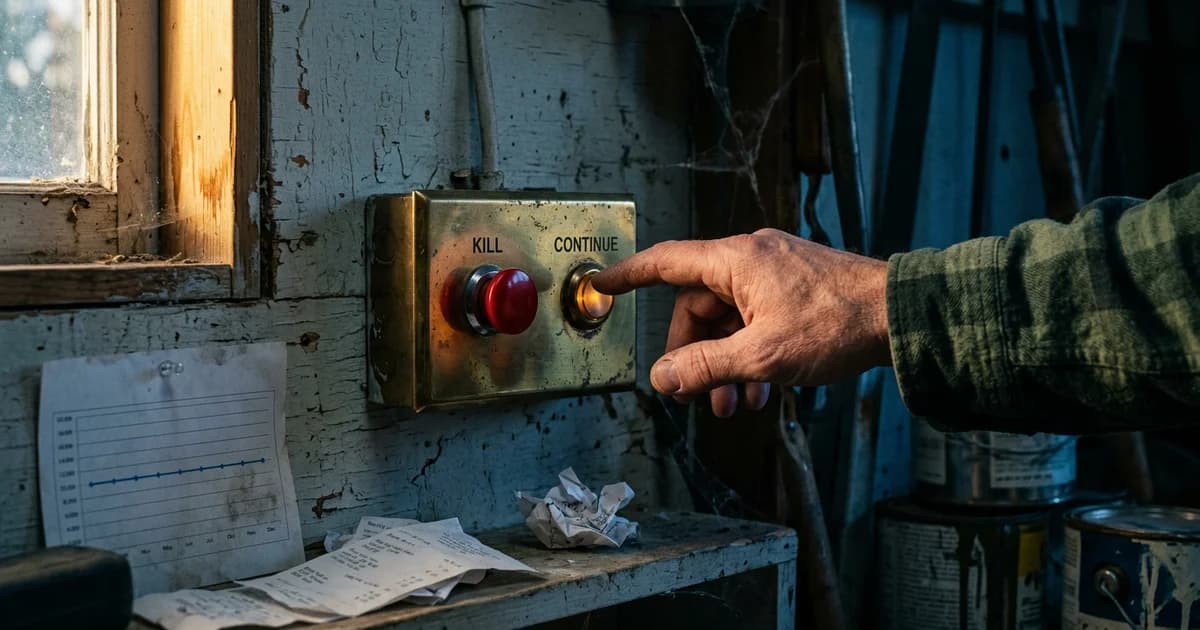
Stanford just proved sunk cost is a dopamine addiction

Every MBA program teaches the same lesson about sunk cost: ignore it. The money is gone, the months are spent, the reputation is already on the line, so the only rational move is to evaluate the future on its own terms. Smart founders, the textbooks say, walk away.
Then why do 90% of startups fail, and why do most of them die clinging to a thesis that stopped working 18 months earlier? A January 2026 paper from Stanford, published in Nature, suggests the textbook answer is wrong. Sunk cost is not a thinking error. It is a chemical reward. The longer you struggle, the more your brain pays you to keep struggling.
What the Stanford team actually measured
The lab of Neir Eshel and Robert Malenka at Stanford Medicine recorded dopamine release inside the nucleus accumbens (the brain's reward hub, sitting in a region called the striatum) while mice worked for identical sugar rewards. Some animals had to press a lever a few times. Others had to press it many more times for the exact same drop of sugar.
The reward was the same. The dopamine response was not. The high-effort group got a noticeably bigger neurochemical hit on delivery, even though the payoff on paper was identical. Effort itself was acting as a value multiplier, written directly into the brain.
The hidden mechanism: a second chemical nobody talks about
Here is where the paper gets interesting. The research, titled "Cholinergic modulation of dopamine release drives effortful behaviour," identified a second neurotransmitter doing the work: acetylcholine.
When effort is high, local interneurons in the nucleus accumbens fire off rapid bursts of acetylcholine. That acetylcholine binds to nicotinic receptors sitting right on dopamine axon terminals and physically amplifies the dopamine release at the moment of payoff. Block the cholinergic signal, and the bonus disappears. Effort no longer feels worth more. The brain stops paying the loyalty premium.
Translation for non-neuroscientists: your reward system has a built-in "you've worked hard for this" multiplier, and it activates without your consent. The harder the road, the bigger the chemical reward when something, anything, feels like progress.
Why this destroys business pivots
Now apply that to the founder who has spent 14 months and $400,000 on a product nobody is buying. Every small win, a meeting that went okay, a single new customer, a slightly less brutal cohort retention chart, lands on a brain that is already primed to overvalue any reward earned through that much effort. The dopamine spike is real. The signal is corrupted.
This is the neurochemical layer underneath the cognitive biases that quietly drain businesses. It is also why fMRI work on escalation of commitment keeps finding the same pattern: people who have invested more do not just rationalize harder, they literally feel the next small reward as larger.
Outside investors looking at the same dashboard see a flat line. The founder, running on amplified dopamine, sees a turning point. Both are looking at identical data. Only one is being paid by their own neurochemistry to stay.
How to use this against your own brain
The Stanford finding is actually liberating once you stop treating sunk cost as a moral failure. It is a circuit, and circuits can be worked around.
Three things help, all backed by what the study implies:
- Move the decision out of your striatum. Hand the call to someone with zero effort invested. A board member, an advisor, a co-founder who joined late. Their dopamine system has not been primed by your 14 months. Theirs is reading the data clean.
- Quantify the reward independent of effort. Before any review meeting, write the metric that would matter if you had launched the product yesterday. If today's number would not impress a stranger, the dopamine you feel about it is the bonus, not the signal.
- Pre-commit to kill criteria. Set the number that would mean stop, in writing, before the next sprint. You cannot rewrite it later when your brain is high on its own loyalty premium. This is where Munger's inversion is the right counterweight: instead of asking how to make this work, ask what would prove it cannot.
The MBA textbook is not wrong about what you should do. It is wrong about why it is hard. You are not being irrational when you refuse to quit a losing bet. You are being chemically rewarded for the refusal. Knowing that is the first move that costs your brain nothing, and changes everything.
Related Reading:
Sources and References
- Nature (peer-reviewed) — January 2026 Stanford study published in Nature: dopamine release in the striatum is amplified by effort, with acetylcholine acting as the local modulator that ties effort intensity to dopamine magnitude on reward delivery.
- Stanford Report — Greater efforts result in increased acetylcholine output that boosts dopamine release on reward delivery, providing a biochemical basis for the sunk cost effect: the harder the work, the bigger the dopamine hit.
- PubMed (Nature, Touponse et al.) — Cholinergic modulation of dopamine release drives effortful behaviour: blocking the cholinergic pathway selectively impairs dopamine responses in high-effort contexts while preserving low-effort reward processing.
- Stanford University — Neir Eshel, MD, PhD, Assistant Professor of Psychiatry and Behavioral Science at Stanford University Medical Center, lead investigator on the cholinergic-dopamine effort study published in Nature January 2026.
- Journal of Corporate Finance — A dataset of 30,602 venture capital investment decisions from 2009-2019 found that the amount of capital previously invested significantly increases the probability of continued investment, confirming the sunk cost fallacy in real business pivots.
Read about our editorial standards →