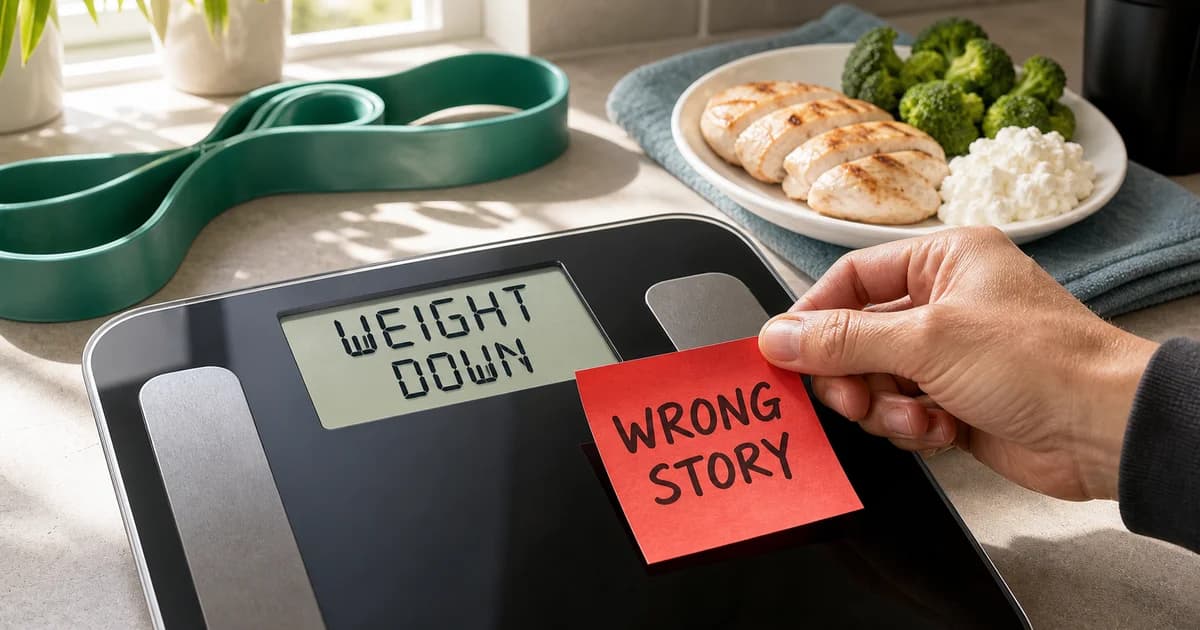
GLP-1 muscle loss is not the story you think

The easiest GLP-1 story to believe is also the least useful one: the scale goes down, so your body must be quietly sacrificing muscle.
The better story is more uncomfortable because it asks for precision. GLP-1 muscle loss can happen during weight loss, but the current evidence does not support the panic version where semaglutide or tirzepatide automatically strip away strength in a uniquely reckless way.
A 2026 systematic review and meta-analysis in Diabetes, Obesity and Metabolism looked across 20 randomized trials and 15,782 participants comparing incretin therapies and lifestyle interventions. The signal was not "no lean mass changes." It was that lean-mass change has to be judged against total weight loss, baseline health, diet quality, and whether the person is protecting function.
GLP-1 muscle loss is real, but the myth is too simple
Lean mass is not the same thing as gym muscle. It includes water, organs, connective tissue, glycogen, and skeletal muscle. When someone loses a substantial amount of body weight, some lean mass commonly moves with it. That is not unique to GLP-1 medications.
The practical question is sharper: are you losing a normal proportion of lean tissue during weight reduction, or are you drifting into functional loss that shows up as weaker lifts, slower walking speed, poor recovery, and less resilience?
That distinction matters because fear can push people toward the wrong response. Medication decisions belong with a clinician. Ignoring protein, resistance training, and strength markers is not a serious plan either.
The scale can improve while function gets neglected
The trap is that body weight updates faster than strength. A smaller number on the scale feels like progress today; a decline in grip strength or stair-climbing power may not feel obvious until months later.
That is why GLP-1 coverage belongs beside broader nutrition literacy. The same reader who worries about lean mass should care about diet signals like ultra-processed foods and attention: food patterns can look fine while hiding a functional cost.
GLP-1s make appetite easier to manage for many people. That can be clinically meaningful. It can also make under-eating protein easier to miss, especially if the daily diet shrinks into whatever feels tolerable.
The Cell Reports Medicine twist: muscle panic misses exercise
A second 2026 paper in Cell Reports Medicine adds the nuance the internet usually deletes. Researchers reported that GLP-1-associated weight loss did not produce disproportionate muscle mass or function loss in obese mice and humans, while exercise remained important.
Read that carefully. It does not say strength training is optional. It says the drug is not the whole story.
Exercise signals that weight loss should not mean surrendering useful tissue. Resistance training tells muscle it is still needed. Protein supplies building blocks. Sleep and recovery help convert the signal into adaptation.
This is where performance habits become health infrastructure. The logic is similar to sleep consistency beating sleep ambition: the boring repeatable behavior often matters more than the heroic protocol people announce online.
What protection looks like without turning into medical advice
No article can tell you what dose, drug, diet, or training plan is right for your body. GLP-1 medications, including semaglutide and tirzepatide, belong in a supervised conversation with a qualified healthcare professional.
But the evidence does support a calmer checklist to discuss and monitor:
- Treat strength as an outcome, not an aesthetic bonus.
- Ask whether your protein intake fits your clinician's plan and your appetite reality.
- Use resistance training as a preservation signal, scaled to your ability.
- Track function: stairs, carries, grip, walking pace, and recovery.
That last point matters because muscle is not the only GLP-1 discussion worth having. Our earlier review of GLP-1 side effects covers why benefits and risks should be held together rather than split into cheerleading or panic.
The cleanest takeaway is not "GLP-1s destroy muscle" or "muscle loss is fake." It is this: weight loss without a function plan is incomplete.
The scale can tell you that mass is moving. It cannot tell you whether your future self is getting stronger, steadier, and more capable. For that, you need the part of the plan the scale never measures.
Related Reading:
Sources and References
- PubMed / Diabetes Obesity and Metabolism — A 2026 systematic review/meta-analysis covered 20 randomized trials and 15,782 participants comparing lean-mass changes across incretin therapies and lifestyle interventions.
- PubMed / Cell Reports Medicine — A 2026 Cell Reports Medicine study reported GLP-1 weight loss did not produce disproportionate muscle mass or function loss in obese mice and humans, while exercise remained important.
Read about our editorial standards →