Creatine for Sleep Loss: Testing the Brain Energy Backup Claim

⚠️ Informational content — does not constitute medical advice.
You’ve pulled an all-nighter, face another early morning after a restless night, or are simply running on a chronic sleep deficit. The immediate reflex is often a second (or third) coffee. But a growing thread of research is pointing to a different, cheaper supplement sitting on gym shelves for decades: creatine. The emerging claim isn't that creatine replaces sleep, but that it might protect specific parts of your cognitive machinery when sleep is unavoidably short. Let's test that claim against the evidence.
Why this matters now
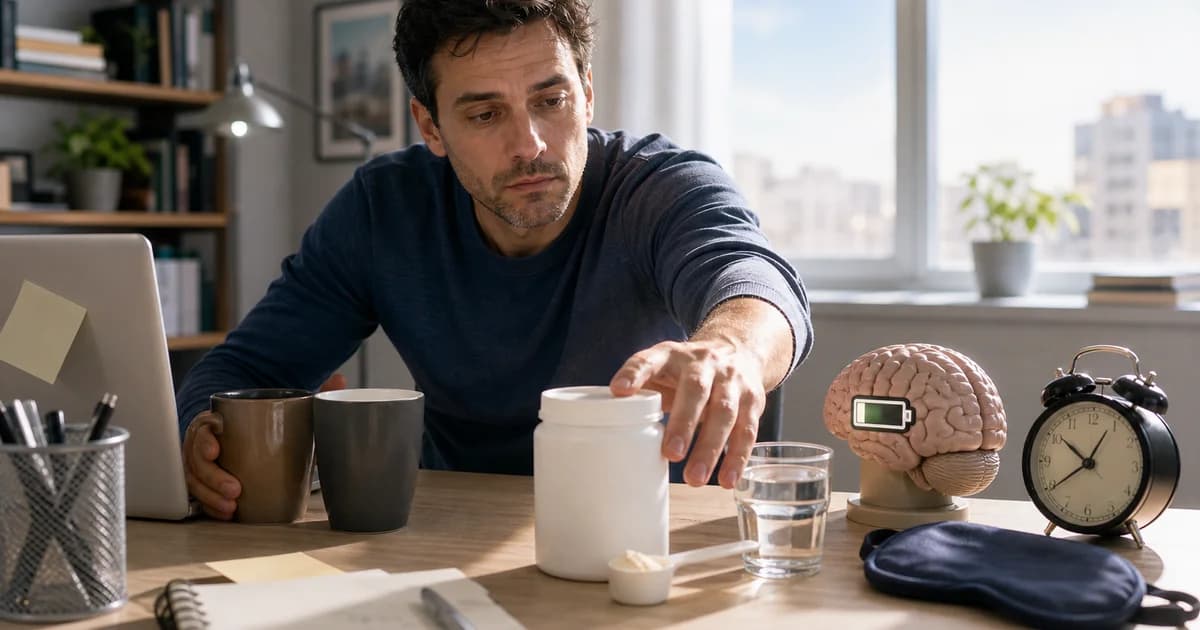
The core hypothesis is biochemical, not magical. Your brain is an energy hog, consuming about 20% of your body's resources despite its small size. Its primary energy currency is adenosine triphosphate (ATP). During sustained mental effort or stress: like the kind imposed by sleep loss: cellular ATP levels can dip. Creatine, stored as phosphocreatine in cells, acts as a rapid recharge system for ATP, helping to maintain energy homeostasis. The theory is that by bolstering this phosphocreatine system, creatine supplementation could help certain energy-intensive cognitive processes stave off the worst effects of sleep deprivation.
A 2024 randomized crossover study published in PubMed Central provides some of the most direct evidence for this idea. Researchers gave participants a high, acute dose of creatine (0.35 grams per kg of body weight) or a placebo before subjecting them to sleep deprivation. They found that creatine administration "improved cognitive performance and brain energy markers during sleep deprivation." Specifically, tasks requiring vigilance, short-term memory, and executive function showed less decline in the creatine group. The study suggests the supplement helped maintain cerebral energy metabolism (phosphocreatine and ATP levels) under the stress of lost sleep. This is a crucial proof-of-concept showing the mechanism might work in humans, at least acutely.
However, the scientific narrative requires a significant twist, as highlighted in a broader 2026 review of the state of research in the journal SLEEP. The review abstract notes that while the premise is promising, the evidence for creatine as a universal cognitive enhancer in well-rested people is far weaker than its proven benefits for muscle strength and energy metabolism. Therefore, the sleep-loss application needs to be framed with narrow, specific claims. It's not a "smart pill" for everyone; it's a potential buffer for a specific physiological state: acute or chronic energy deficit in the brain due to poor sleep. This is similar to how we must scrutinize other supplement claims, like the recent reanalysis that showed the Taurine longevity hype is dead. Context and specific conditions matter immensely.
What changes in practice
So, what does this mean if you're considering trying it? First, understand the gap it might fill. Coffee and other stimulants like caffeine work primarily by blocking adenosine receptors, making you feel less tired. They don't necessarily fix the underlying brain energy deficit; they mask the signal. Creatine, in theory, addresses the energy supply side. It's not about feeling awake, but about supporting the brain's computational hardware when its normal maintenance window (sleep) has been missed. This isn't about optimizing peak performance but mitigating decline.
Dosing in the research varies. The 2024 study used a large acute dose. More practical, longer-term protocols often involve a "loading phase" of 20 grams per day (split into 4 doses) for 5-7 days, followed by a maintenance dose of 3-5 grams daily. It's one of the most researched supplements globally, with a strong safety profile for healthy individuals at these doses, though consulting a healthcare professional is always advised.
Crucially, this is not a substitute for sleep. Sleep is non-negotiable for memory consolidation, metabolic clearance, and overall health. Think of creatine in this context as a potential tactical tool for unavoidable crunches, not a strategic lifestyle hack. It’s a patch, not an upgrade. Relying on any supplement to chronically replace sleep is a path to diminished returns and health issues, much like relying on processed foods for energy, a topic we explored in The 10% Ultra-Processed Food Attention Loophole.
The bottom line? The claim that creatine can protect aspects of cognition under sleep loss has moved from pure theory into early, promising human trials. The mechanism: propping up the brain's cellular energy reserves: is plausible and distinct from stimulants like caffeine. However, the research is still emerging and points to a specific, narrow use case: mitigating decline during known periods of sleep deprivation. It’s a cheap, well-tolerated supplement with a potential secondary benefit that’s worth understanding. But it doesn't replace your second coffee; it attempts to solve a different part of the sleep-loss problem. Your best strategy remains prioritizing sleep, using caffeine strategically for alertness, and considering creatine as a possible, evidence-informed backup for your brain's energy grid during unavoidable outages.
Sources and References
- SLEEP / Oxford Academic — A May 2026 SLEEP abstract reviews the state of research on creatine for preserving cognitive performance during sleep loss.
- PubMed Central — A 2024 randomized crossover study found that a high acute dose of creatine improved cognitive performance and brain energy markers during sleep deprivation.
- PubMed Central — Creatine research is stronger for muscle and energy metabolism than for universal cognitive enhancement, so the sleep-loss angle needs narrow claims.
Read about our editorial standards →