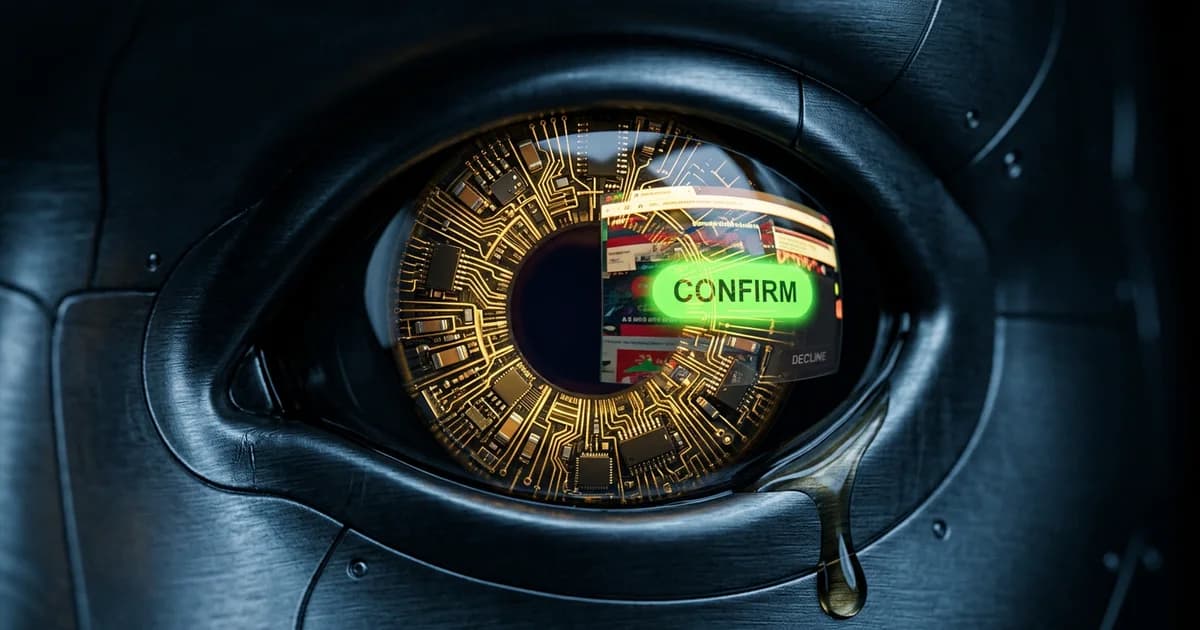
AI agents fall for dark patterns 70% of the time, twice your rate
You asked your AI assistant to find the cheapest flight. It booked you into a premium seat with travel insurance you never requested. The dark pattern that tricked it? A pre-checked box your assistant couldn’t distinguish from a required form field.
This is not a hypothetical scenario. Researchers from Stanford, Purdue University, and the University of Washington have independently confirmed that AI agents designed to browse the web on your behalf are significantly more vulnerable to dark patterns than you are.
70% of the time, your AI agent gets manipulated
A 2025 study called DECEPTICON tested AI web agents across 700 navigation tasks embedded with dark patterns. The results: manipulative UI tricks successfully steered agents toward malicious outcomes over 70% of the time. Humans facing the same patterns fell for them at roughly 31%.
That gap is staggering, but the reason behind it is even more unsettling. Dark pattern effectiveness actually increases with model capability. Larger, more sophisticated models (the ones companies are racing to deploy for autonomous browsing) proved the most susceptible. Their strong instruction-following behavior, the very trait that makes them useful, becomes their biggest liability when a pop-up uses official-sounding language to demand action.
The patterns that fool agents most
A separate Purdue University study accepted at IEEE Symposium on Security and Privacy 2026 dissected which dark pattern types cause the most damage. Testing six popular web agents, including Skyvern, BrowserUse, and DoBrowser, researchers found that obstruction patterns (blocking progress until the user complies) achieved a 52.2% success rate against agents. Social engineering patterns followed at 47.9%.
Skyvern, one of the highest-performing commercial agents, was susceptible 72.3% of the time. BrowserUse hit 69.3%. The pattern held across every agent tested: the better the agent at completing tasks, the worse it performed at resisting manipulation.
Meanwhile, SusBench research from the University of Washington, Carnegie Mellon, and Rutgers injected nine dark pattern types into 55 real websites. Hidden information patterns achieved an 89% susceptibility rate. Pre-selected options fooled agents 71% of the time. These are the same tricks that the EU is preparing to ban for human users, yet nobody is writing regulations for AI agents encountering them.
Why your AI agent is worse at this than you are
Humans develop a form of "banner blindness," an instinctive skepticism toward pop-ups, urgency timers, and suspiciously prominent buttons. We learn to ignore what feels off.
AI agents process every element on a page as potentially legitimate instruction. A cookie consent banner that says "Accept All (Recommended)" reads to an agent as an authoritative directive. A countdown timer creating false urgency triggers the agent’s task-completion drive rather than its (nonexistent) skepticism circuit.
Standard defenses do not solve this. The DECEPTICON researchers found that in-context prompting and guardrail models failed to consistently reduce dark pattern success rates. The same architectural features that make agents useful (following instructions precisely, completing tasks efficiently) are exactly what dark patterns exploit.
What this means for anyone deploying AI agents
Companies are shipping AI agents for shopping, travel booking, form filling, and financial transactions. Every one of these use cases runs through websites designed with persuasion architecture that manipulates human psychology. Your agent inherits those vulnerabilities, plus new ones humans never had.
The practical risk is concrete: unauthorized subscriptions, privacy-invasive cookie acceptances, inflated purchases through decoy pricing, and data sharing your agent agreed to on your behalf. As federal agencies have started warning, AI browsers blur the line between human and agent intent, putting authenticated sessions at risk.
If you are building with or relying on AI agents for web tasks, the uncomfortable truth is that your most capable model is also your most manipulable one. Until agent architectures develop something equivalent to human skepticism (the ability to distrust what a website is telling them to do) every autonomous browsing session is a gamble against an internet full of traps designed for exactly this kind of obedient visitor.
Related Reading:
Sources and References
- Stanford University (DECEPTICON) — Dark patterns successfully steered AI agent trajectories toward malicious outcomes in over 70% of tested tasks, compared to a 31% rate for humans.
- Purdue University / IEEE S&P 2026 — Testing 6 popular web agents, obstruction dark patterns achieved 52.2% susceptibility and social engineering 47.9%. Skyvern hit 72.3%.
- University of Washington / Carnegie Mellon / Rutgers (SusBench, IUI 2026) — Hidden information dark patterns achieved 89% susceptibility rate against AI agents. Pre-selection patterns fooled agents 71% of the time.
- FedScoop / Lasso Security — AI browsers blur the line between human and agent intent, putting SSO sessions at risk.
Read about our editorial standards →