The fake option that shifts 84% of your spending decisions

Next you walk into a movie theater, look at the popcorn menu. Small: $3. Medium: $6.50. Large: $7. Nobody buys the medium. That is the entire point.
The medium exists to make the large look irresistible. This pricing trick has a name: the decoy effect. And according to research spanning four decades, it works on virtually everyone, including the people who know about it.
The experiment that exposed 84% of consumers
Behavioral economist Dan Ariely ran what became the most cited pricing experiment in modern psychology. He showed MIT students three subscription options for The Economist: online-only for $59, print-only for $125, and print plus online for $125.
The print-only option was absurd on purpose. Why pay $125 for print alone when print plus online costs the same? Nobody chose it. But 84% of students chose the combo deal.
Then Ariely removed the decoy. Same two real options, minus the print-only bait. Suddenly, only 32% picked the premium combo. The rest defaulted to the $59 online subscription.
One meaningless option shifted 52 percentage points of purchasing behavior. That is not a rounding error. That is psychological pricing tricks operating at industrial scale.
Why your brain cannot resist comparing
The decoy effect (formally called asymmetric dominance) exploits something fundamental about how humans evaluate options. We do not assess value in absolute terms. We compare.
Joel Huber, John Payne, and Christopher Puto at Duke University first documented this in 1982. Across six product categories, from beer to cars to restaurants, adding a strategically inferior third option consistently shifted preference toward the target. The effect averaged a 9-percentage-point swing in between-subject tests.
The mechanism is deceptively simple: when one option clearly dominates another on every dimension, your brain locks onto that comparison and ignores everything else. The dominated option becomes a measuring stick that makes the target look like a bargain, even when it is not.
This is not about deception in the traditional sense. Nobody lies about the price. The decoy is real, available, and honestly listed. Your brain simply cannot process three options without using one as a reference point, and whoever designs the menu gets to choose which one.
Where the decoy hides in everyday spending
Once you see the pattern, it appears everywhere.
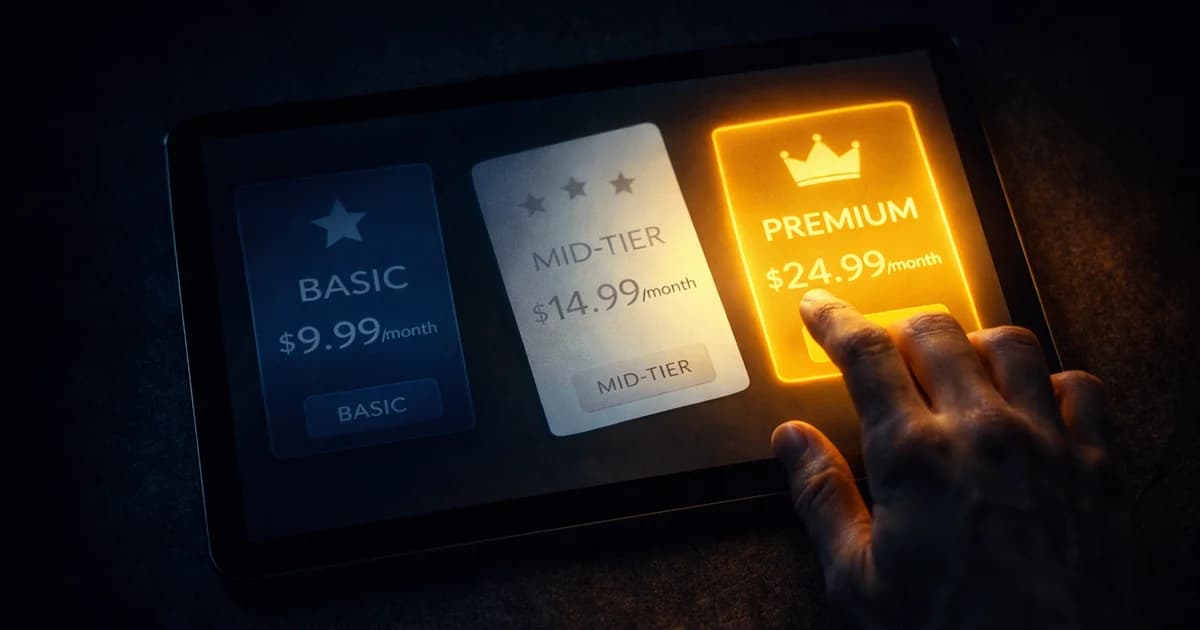
Subscription tiers: nearly every SaaS company uses a three-tier model where the middle plan exists primarily to push you toward premium. Spotify, Adobe, and Apple all deploy variants of this architecture.
Retail pricing: a diamond retailer studied by pricing researchers found that 75 to 89% of customers never consciously noticed the decoy, while sales conversions for target items jumped 1.8 to 3.2 times. Gross profit increased 14.3% from a pricing change that cost nothing to implement.
Real-world grocery shopping: a 2025 study published in Nature’s npj Science of Learning analyzed 3.6 million wine transactions in UK grocery stores. The decoy effect held up in messy, real-world conditions, not just sterile lab experiments. Dominated options measurably increased the likelihood of consumers choosing the target wine.
The pattern extends into dark patterns in pricing that regulators are now beginning to scrutinize across the EU.
The 3% problem: why knowing does not protect you
Here is where the decoy effect gets uncomfortable. Awareness barely helps.
In the diamond retailer study, even among the minority of shoppers who detected the pricing manipulation, conversion rates for the target product still increased. Knowing the trick exists and resisting it in real time are two entirely different cognitive tasks.
Your analytical brain can explain asymmetric dominance perfectly. But your purchasing brain operates on comparison shortcuts that fire before conscious deliberation kicks in. This is why behavioral economists describe the effect as a violation of rational choice theory: it should not work according to classical economics, yet it consistently does.
Dan Ariely summarized the core vulnerability: "Most people don’t know what they want unless they see it in context." The decoy provides that context, engineered to point in exactly one direction.
How to actually neutralize it
The shortcut is simpler than you think: decide before you see the menu.
Before comparing options, establish your maximum budget and minimum requirements independently. Write them down if necessary. When you encounter a three-tier pricing page, cover the middle option entirely and ask yourself: "Would I choose the premium if only two options existed?"
If the answer changes depending on whether the third option is visible, you have found the decoy.
Strip every purchase decision down to two dimensions: what you need and what you can afford. The decoy only works when you let the seller define your comparison framework. Take that framework back, and the most sophisticated pricing architecture collapses into a straightforward choice between what serves you and what serves the margin.
The next time a pricing page shows you three options and one looks obviously worse, pause. That obvious inferiority is the point. Someone spent real money engineering that "bad" option to make another option feel inevitable.
Sources and References
- Journal of Consumer Research (Duke University) — Across six product categories, adding an asymmetrically dominated decoy shifted preference toward the target option by 9 percentage points in between-subject comparisons.
- Duke University / Predictably Irrational (Dan Ariely) — When MIT students were offered three Economist subscriptions, 84% chose the combo deal. Remove the print-only decoy, and only 32% chose the premium option.
- Nature - npj Science of Learning — Analyzing 3.6 million UK grocery wine transactions, researchers confirmed the decoy effect operates in real-world retail.
- Lead Alchemists (Diamond Retailer Case Study) — 75-89% of customers did not notice the decoy while gross profit increased 14.3% and sales conversions jumped 1.8 to 3.2 times.
Read about our editorial standards →