Your home is making you sick (and spas won't fix it)

Your thermostat, your paint, your LED fixtures, your neighbor's lawnmower filtered through a single-pane window: the average living room contains more chemical complexity than most people encounter in an outdoor environment on a smoggy day. According to the EPA's landmark TEAM Study, indoor VOC concentrations run 2 to 5 times higher than the outdoor air they're supposed to be an escape from — and during activities like stripping furniture or repainting a bedroom, that gap can reach 1,000 times.
This is not a story about chemical sensitivity or rare exposure scenarios. It's a story about the invisible baseline your body lives inside, all day, every day. The $584 billion "wellness home" industry will try to sell you a solution: polished stone countertops, infrared saunas, himalayan salt lamps. What they won't mention is that the three factors with the most measurable biological impact cost almost nothing to address — and none of them look remotely spa-like.
The air you're breathing right now
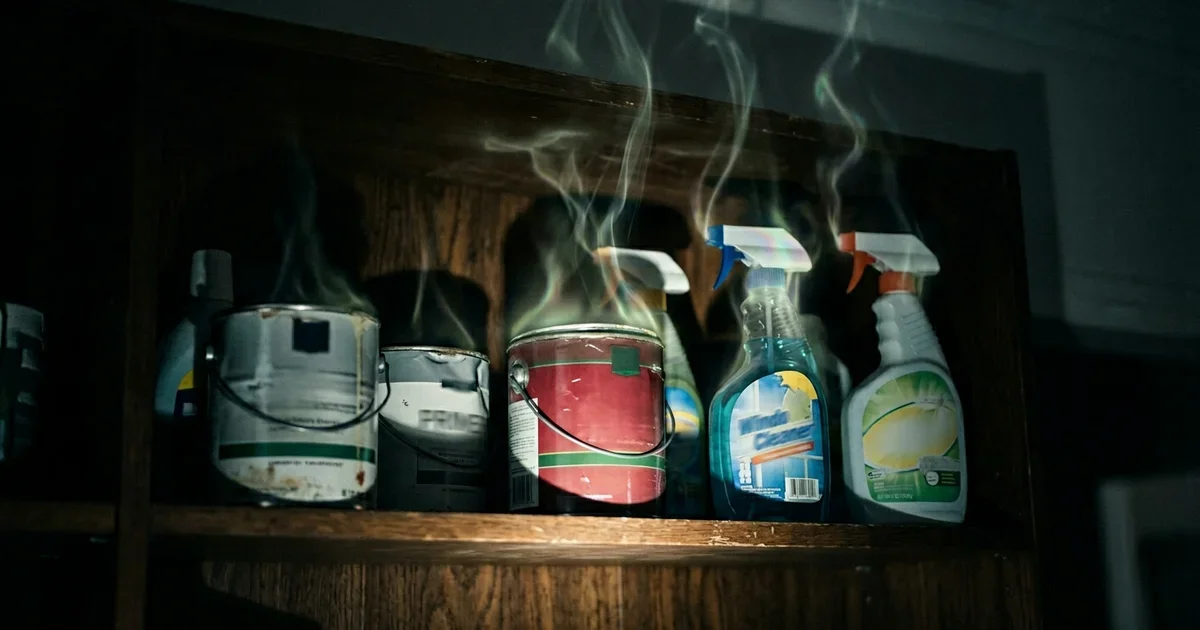
VOCs (volatile organic compounds, essentially molecules that float easily into the air at room temperature) are off-gassed by paint, cleaning products, adhesives, furniture finishes, scented candles, and air fresheners. What makes this unsettling is not just the concentration. It's the source list: the things most people reach for to make a home feel clean and pleasant are often the same things raising VOC levels.
Headaches, eye irritation, brain fog, and nausea are short-term symptoms tied to elevated indoor VOC exposure. At higher concentrations, the EPA notes potential liver, kidney, and central nervous system damage. The practical fix is brutally unglamorous: ventilate aggressively (open two windows on opposite sides of the space for cross-ventilation), choose low-VOC paint labeled with a certified emissions limit, and stop buying synthetic air fresheners.
No granite. No infrared. Just airflow.
What your light is doing to your hormones
Your body does not have a standalone "sleep button." It has a circadian system (a roughly 24-hour internal clock built around light cues), and every light source in your home is either calibrating that system correctly or slowly breaking it.
The specific problem is blue-wavelength light, which is abundant in standard LED bulbs and screens. When blue light hits the retina in the evening, it signals the suprachiasmatic nucleus (the brain's master clock) to halt melatonin production. A 2024 study found that after just two hours of blue light exposure, melatonin levels sat at 7.5 pg/mL, while the same duration of red light allowed recovery to 26.0 pg/mL. That's a 3.5x difference in a hormone that governs not just sleep onset, but immune function, cellular repair, and mood regulation.
The upgrade that actually moves this needle is not a $300 smart bulb ecosystem. It's switching bedroom and living room lights after 8pm to warm-toned bulbs (2700K or below), or using a single amber lamp in the hours before sleep. Behavior is the mechanism. The product is secondary.
The noise your body is registering without your permission
Traffic hum, air conditioning cycling, upstairs footsteps, a refrigerator compressor: low-level ambient noise is so constant that most people stop consciously hearing it. The stress response system does not.
A systematic review of 133 studies found that occupational noise at or above 85 dB increased hypertension risk by 35% and pushed systolic blood pressure up by an average of 5.26 mmHg. That's a meaningful cardiovascular number from sound alone. The mechanism is the body's threat-detection circuitry: even unnoticed noise activates the hypothalamic-pituitary-adrenal axis (the stress hormone system), releasing cortisol and keeping physiological systems in a low-grade fight-or-flight state.
The fix is not a $900 noise-canceling headphone paired to a sleep app. It's moving your bed away from the wall shared with the street, using a white noise machine to mask irregular sounds (irregular spikes are harder on the nervous system than constant hum), and sealing window gaps with inexpensive draft weatherstripping.
Why the wellness industry can't sell you this
The three interventions above (aggressive ventilation, warm-toned evening lighting, and noise masking) cost under $50 combined. That's the problem. A market that depends on premium products for premium prices cannot build a campaign around "open your windows" or "change one lightbulb."
What the industry sells instead is aesthetics dressed as biology. Granite is beautiful and easy to wipe down; it does not meaningfully change the air you breathe. An infrared sauna is a real recovery tool with real data behind it; it does not address the fact that your bedroom's light spectrum is quietly suppressing melatonin every evening before you use it.
Biology doesn't care what something looks like. It responds to inputs: chemical concentrations in the air, light wavelengths at specific times of day, acoustic signals the nervous system interprets as threat or safety.
Your home is already sending your body those inputs, constantly. The only question is whether they're calibrated to help you or slowly working against you.
Sources and References
- U.S. Environmental Protection Agency (EPA) — The EPA's TEAM Study found indoor VOC concentrations run 2 to 5 times higher than outdoors, spiking to 1,000 times background levels during activities like paint stripping.
- PMC / National Institutes of Health — After two hours of blue light exposure, melatonin sat at just 7.5 pg/mL vs 26.0 pg/mL under red light, a 3.5x difference in a hormone governing sleep, immune function, and cellular repair.
- PMC / National Institutes of Health (133-study meta-analysis) — A meta-analysis of 133 studies found occupational noise at or above 85 dB increases hypertension risk by 35% and elevates systolic blood pressure by an average of 5.26 mmHg.
- npj Biological Timing and Sleep (Nature) — Afternoon to early evening bright light exposure measurably reduces melatonin production hours later, confirming that circadian disruption begins well before bedtime.
Read about our editorial standards →