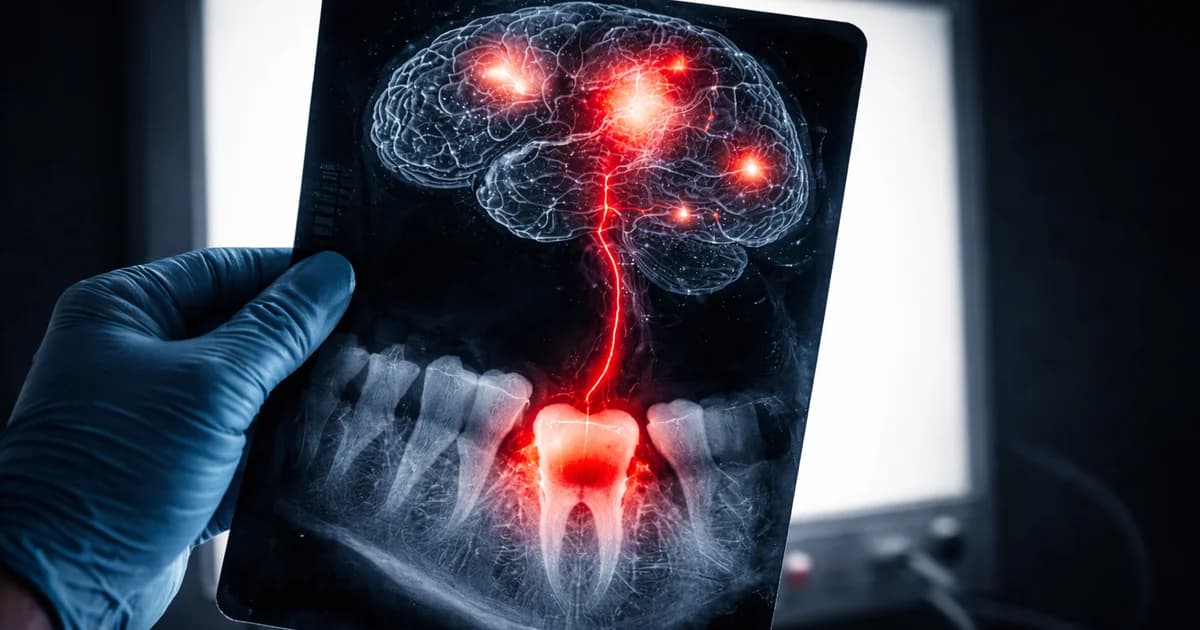
The gum disease secret your dentist never connected to your brain

Almost half the adults around you have a silent infection right now, and it is slowly eating into their brains.
That is not hyperbole. A 2025 study published in Neurology Open Access by the American Academy of Neurology examined 1,143 older adults and found that those with gum disease had 56% higher odds of severe white matter brain damage compared to those with healthy gums. White matter hyperintensities, the clinical term for these bright spots on brain scans, signal areas where tissue has broken down. When enough of this tissue deteriorates, memory falters, reasoning slows, and stroke risk climbs.
But here is what your dentist probably never mentioned: the damage does not stay in your mouth.
The bacteria that crosses the blood-brain barrier
The villain has a name: Porphyromonas gingivalis, the primary pathogen behind chronic gum disease. In a landmark 2019 study published in Science Advances, researchers led by Stephen Dominy found this bacterium living inside the brains of deceased Alzheimer's patients. Not just traces of it. The team detected gingipains (toxic enzymes produced by P. gingivalis) concentrated in the hippocampus, the brain's memory center, at levels that correlated directly with the severity of tau tangles and amyloid plaques, the two hallmarks of Alzheimer's disease.
When the researchers infected mice with P. gingivalis orally, the bacteria colonized their brains within weeks and triggered increased production of amyloid-beta 1-42, the specific protein fragment that forms Alzheimer's plaques.
Your mouth bacteria does not just cause inflammation at a distance. It physically moves into your brain and starts building the architecture of dementia.
Six times faster cognitive decline
If the brain colonization finding sounds alarming, the clinical numbers are worse. A study published in PLOS ONE by Ide and colleagues tracked 59 people with mild to moderate Alzheimer's disease over six months. Those who also had periodontitis experienced a six-fold increase in the rate of cognitive decline compared to Alzheimer's patients with healthy gums.
The mechanism the team identified was systemic inflammation: gum disease drove down levels of IL-10 (the body's anti-inflammatory brake) while spiking TNF-alpha (a pro-inflammatory signal). In essence, chronic gum infection keeps your immune system in overdrive, and that constant inflammatory fire reaches the brain.
Six times faster. Not 10% faster. Not double. Six times.
47% of adults are already at risk
According to data from the CDC and NIDCR, 47.2% of American adults over 30, roughly 64.7 million people, have some form of periodontal disease. Among adults 65 and older, the number approaches 60%. The rates climb further for smokers (62.4%), people with diabetes (59.9%), and those living below the poverty line (60.4%).
This is not a rare condition hiding in medical journals. Nearly half the adult population is walking around with the very infection now linked to accelerated brain aging, and most of them have no idea.
The early stages of gum disease are painless. Your gums might bleed when you brush. They might look slightly redder than usual. You might notice bad breath that does not go away. These are signals your body is already fighting P. gingivalis, and every day you ignore them, the bacteria have another opportunity to enter your bloodstream and potentially reach your brain.
The cheapest intervention science has found
Here is the part that should frustrate you: the solution costs almost nothing.
A toothbrush, floss, and two minutes twice a day. That is the frontline defense against the bacterium now linked to accelerated Alzheimer's progression and measurable brain tissue damage. Dental cleanings, typically recommended every six months, remove the hardened bacterial colonies (tartar) that brushing alone cannot reach. The cost varies by country and insurance coverage, but it is among the most affordable preventive medical interventions available anywhere.
The 2019 Science Advances study went further. Researchers developed a compound called COR388 (a gingipain inhibitor) that, when given to infected mice, reduced P. gingivalis levels in the brain, blocked amyloid production, lowered neuroinflammation, and rescued dying neurons in the hippocampus. While this drug is still in clinical trials for humans, the principle it validates is simple: stop the bacteria, slow the damage.
You do not need to wait for a pharmaceutical breakthrough. You can start disrupting this pathway tonight.
What to do starting today
The research points to a clear protocol:
- Brush twice daily for two full minutes. Most people brush for under 45 seconds. Set a timer.
- Floss or use interdental brushes every day. P. gingivalis thrives in the spaces between teeth where bristles cannot reach.
- Get professional cleanings on schedule. If you have not seen a dentist in over a year, book an appointment. Tartar removal is something only professional tools can accomplish.
- Watch for warning signs. Bleeding gums, persistent bad breath, receding gumlines, or loose teeth are not normal aging. They are active infection.
- If you already have periodontitis, ask your dentist about scaling and root planing (a deep cleaning procedure that removes bacteria below the gumline). Treatment can halt progression.
As Dr. Souvik Sen, the lead researcher on the 2025 white matter study, put it: "Gum disease is preventable and treatable. If future studies confirm this link, it could offer a new avenue for reducing cerebral small vessel disease by targeting oral inflammation."
The most sophisticated longevity interventions are making headlines: rapamycin, NAD+ precursors, hyperbaric oxygen. Meanwhile, the tool with some of the strongest evidence for protecting your brain from accelerated aging has been sitting next to your bathroom sink this whole time.
The question is not whether you can afford to floss. It is whether you can afford not to.
- #P. gingivalis brain
- #white matter hyperintensities gum disease
- #gum disease Alzheimer's risk
- #gum disease cognitive decline
- #oral health dementia prevention
- #longevity oral health
- #periodontal disease brain damage
Sources and References
- American Academy of Neurology / Neurology Open Access — People with gum disease had 56% higher odds of falling into the highest group of white matter hyperintensities (brain damage markers) in a study of 1,143 adults with average age 77.
- PLOS ONE (Ide et al., 2016) — Periodontitis was associated with a six-fold increase in the rate of cognitive decline over 6 months in 59 Alzheimer's patients, mediated through systemic inflammation (IL-10 decrease, TNF-alpha increase).
- Science Advances (Dominy et al., 2019) — P. gingivalis and its toxic gingipains were found in the brains of Alzheimer's patients, with levels correlating to tau and amyloid pathology. A gingipain inhibitor (COR388) reduced bacterial brain load and rescued hippocampal neurons in mice.
- CDC / NIDCR (National Institute of Dental and Craniofacial Research) — 47.2% of American adults over 30 (64.7 million people) have periodontal disease. Prevalence rises to nearly 60% in adults 65+.
Read about our editorial standards →