Robo-advisors fix 4 of 5 investor biases: the one they cannot fix is costing you the most

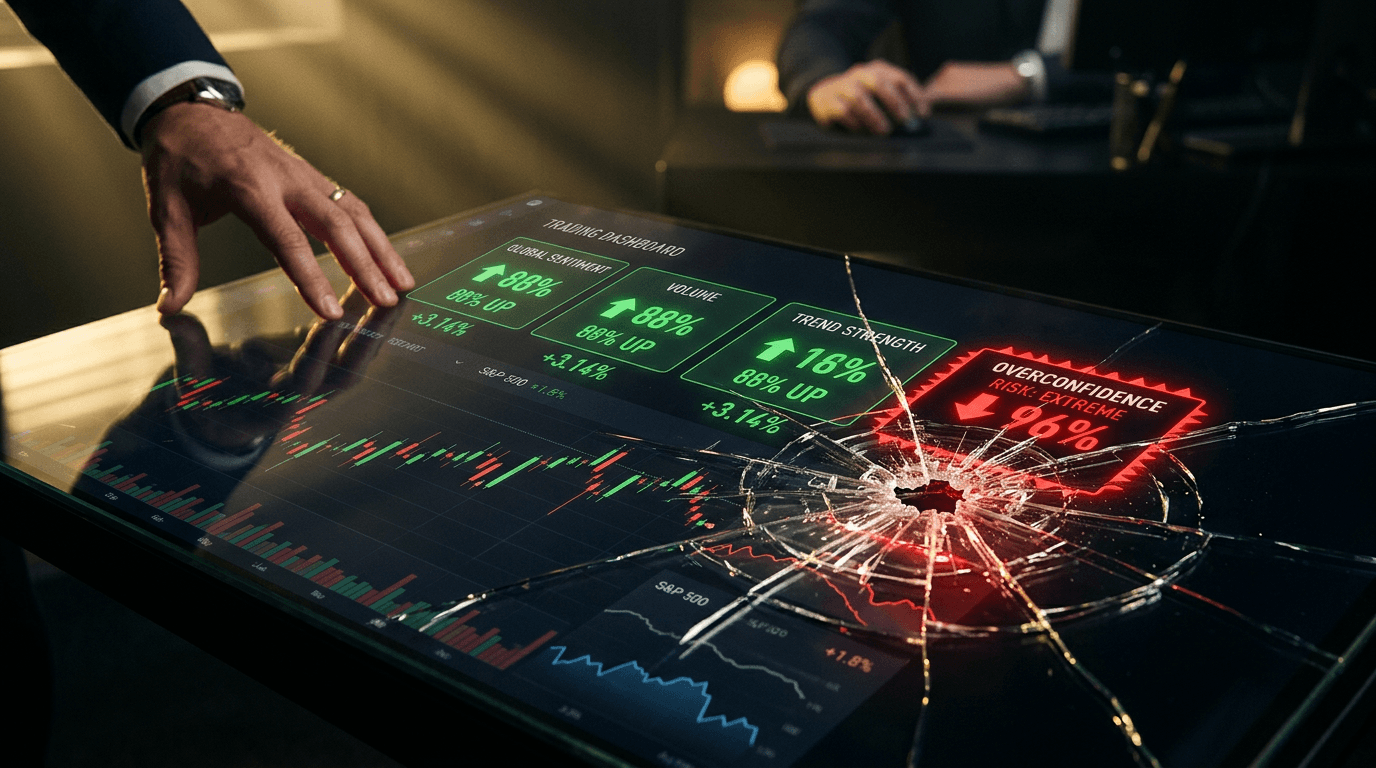
Four out of five. That is the score your robo-advisor achieves against the cognitive biases most likely to sabotage your portfolio. Anchoring, loss aversion, availability bias, representativeness: all significantly moderated by algorithmic management, according to a 2025 study of NYSE investors published in Acta Psychologica. The fifth bias, overconfidence, passed through every algorithmic filter untouched.
That single gap matters more than the other four combined.
Why robo-advisors succeed against four biases
The logic is straightforward. Robo-advisors automate the decisions that trip up human intuition. When markets drop, a well-designed algorithm rebalances your portfolio toward lower-risk assets without waiting for you to panic, hesitate, or anchor to a price that no longer reflects reality. Researchers at the University of Minnesota found that during the COVID-19 crash, robo-advisor users gained a 12.67% performance advantage over human-only investors, precisely because the algorithms adjusted risk levels while humans froze.
Loss aversion (the tendency to fear losses more than you value equivalent gains) gets neutralized when an algorithm executes sell decisions without emotional weight. Anchoring (fixating on a purchase price as a reference point) disappears when rebalancing follows predetermined thresholds, not memory. Availability bias (overweighting recent dramatic events) loses its grip when portfolio adjustments follow statistical models rather than headlines. Representativeness bias (assuming small patterns predict large outcomes) fades when diversification rules override gut feelings.
These four biases share one trait: they operate on inputs the algorithm can intercept. The decision point sits between your emotional reaction and the trade execution. Robo-advisors insert themselves at exactly that junction.
The overconfidence exception nobody discusses
Overconfidence operates differently. It does not live in the moment of execution. It lives upstream, in the decisions you make before the algorithm ever gets involved: which platform you choose, how much risk you select in your questionnaire, whether you override the recommended allocation, and how often you check and adjust your portfolio.
A 2024 review in Frontiers in Behavioral Economics identified the core problem: robo-advisors reduce reliance on System 1 thinking (fast, instinctive reactions), but they cannot eliminate the human element from the data they process. Overconfident investors feed the algorithm distorted inputs from the start.
Here is what that looks like in practice. An investor who overestimates their risk tolerance selects an aggressive allocation profile. The robo-advisor faithfully executes that profile, amplifying rather than correcting the underlying miscalibration. The technology performs exactly as designed. The problem is that it was designed around a lie the investor told themselves.
Research on five cognitive biases that cost investors thousands documents that behavioral errors compound silently. Overconfidence is especially dangerous because it feels like competence. Loss aversion feels like anxiety; you can recognize it. Anchoring feels like stubbornness; a friend might point it out. Overconfidence feels like knowledge.
The amplification trap
The data on excessive trading makes this worse. Research from the American Economic Association tracking over 35,000 households found overconfident investors trade roughly 45% more frequently, incurring annual return penalties between 1% and 3%. Combine that behavior with the frictionless interface of a robo-advisor (where executing a trade takes seconds, not a phone call to a broker) and you get a paradox: the tool designed to reduce emotional trading actually lowers the barrier to impulsive trading for people who believe they know better.
This is not a design flaw in robo-advisors. It is a category error in how the industry markets them. The promise is bias-free investing. The reality is bias-reduced investing, with one critical blind spot.
Investors who already believe they understand markets better than average (roughly 74% of individual investors, according to behavioral finance surveys) see the robo-advisor as confirmation of their strategy rather than a correction to it. As investors who should fear their own behavior more than the market illustrates, the gap between perceived competence and actual returns keeps widening.
What actually works against overconfidence
The fix is not more automation. It is structured friction. Three approaches show promise in the research:
Pre-commitment contracts. Before market volatility hits, define the exact conditions under which you will (and will not) adjust your portfolio. Write them down. An algorithm cannot override your overconfidence, but a written rule you created during a calm moment can.
Outcome journaling. Track every prediction you make about the market with a specific timeframe and metric. Most overconfident investors stop overriding their robo-advisor within three months of honest record-keeping, because the data forces a confrontation between belief and reality.
Asymmetric friction. Make it easy to deposit money and hard to change your allocation. Some platforms already implement cooling-off periods for allocation changes. The most effective ones require a 48-hour delay before any manual override takes effect.
The robo-advisor industry manages over $2 trillion in assets globally, with projected growth around 13% annually through 2027. That scale makes the overconfidence blind spot a trillion-dollar problem, not a footnote. The four biases these platforms fix are real victories. The one they cannot fix is the one that compounds every year you ignore it.
Sources and References
- Acta Psychologica / ScienceDirect (2025) — NYSE study: robo-advisors moderate 4 of 5 cognitive biases, overconfidence resists.
- University of Minnesota Carlson School (2023) — Robo-advisor users achieved 12.67% performance advantage during COVID-19 crash.
- Frontiers in Behavioral Economics (2024) — Robo-advisors reduce System 1 thinking but cannot eliminate subjective human inputs.
- American Economic Association — Overconfident investors trade 45% more frequently with 1-3% annual return penalties.
Read about our editorial standards →