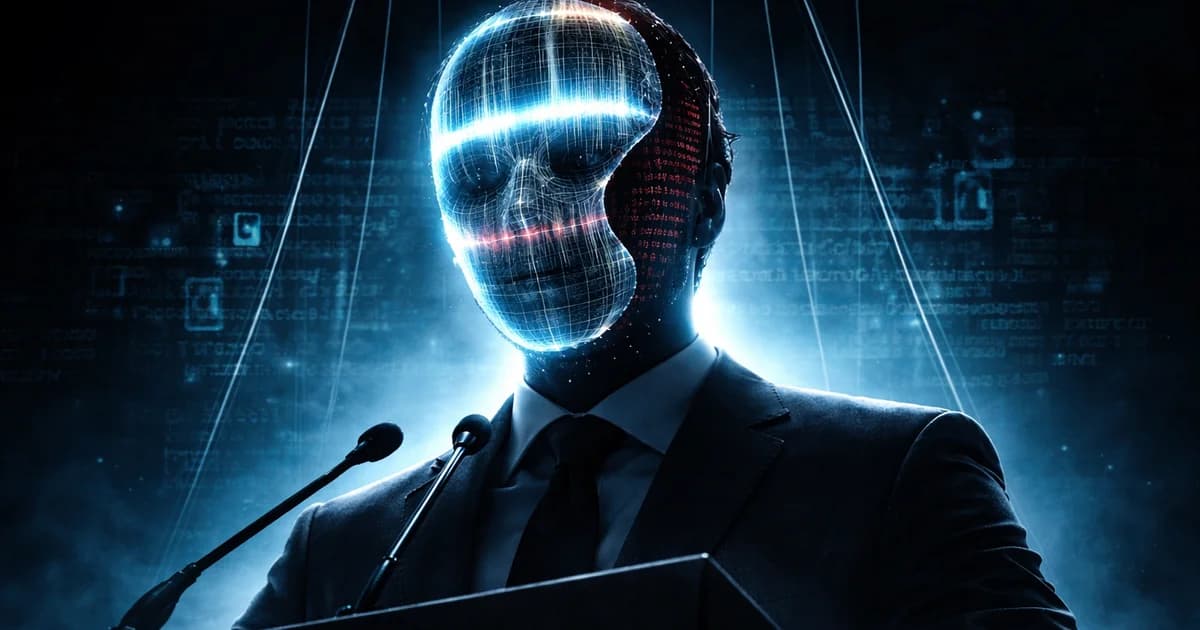
80% of companies have no defense against deepfake voice fraud

It costs three seconds. That is how much audio a modern AI tool needs to clone your CEO's voice with 85% accuracy, according to McAfee research. Not three minutes. Not three hours. Three seconds of a quarterly earnings call, a conference keynote, or a podcast interview, and your company's voice authentication is obsolete.
The $680,000 phone call nobody saw coming
Deepfake voice fraud is draining enterprises at a pace most boards refuse to acknowledge. The average large enterprise loses $680,000 per successful attack, and CEO fraud now targets over 400 companies daily. Yet 80% of organizations have zero response protocol in place for voice-based deepfake attacks.
The economics make this inevitable. Creating a convincing voice clone costs less than $15 and takes under 20 minutes. The Biden robocall deepfake that disrupted a 2024 primary election was produced for roughly $1. Meanwhile, deepfake-as-a-service platforms have turned what was once a nation-state capability into something any motivated fraudster can purchase.
How a 3-second clip becomes a $25 million heist
In February 2024, a finance worker at engineering giant Arup joined what appeared to be a routine video call with the company's CFO and several senior executives. Every person on that call, except the victim, was an AI-generated deepfake. The result: $25 million wired to fraudsters before anyone realized what happened.
This was not an anomaly. It was a preview. Deepfake fraud losses hit $1.1 billion in 2025, and Deloitte projects U.S. AI fraud losses will reach $40 billion by 2027 at a 32% annual growth rate. The first quarter of 2025 alone saw $200 million in North American losses.
What makes voice cloning particularly dangerous is its invisibility. Humans detect high-quality deepfake video only 24.5% of the time. Audio deepfakes are even harder to catch because there is no visual uncanny valley to trigger suspicion.
Why your current defenses are already outdated
Legacy voice biometric systems analyze physical characteristics like pitch and tone. Generative AI creates digital twins with those exact mathematical characteristics, producing a positive match to fraudulent audio. Your voice authentication is not just vulnerable; it is actively confirming the attacker's identity as legitimate.
Gartner's September 2025 survey found that 62% of organizations had already experienced deepfake attacks involving social engineering or automated process exploitation. Only 31% of executives believed deepfakes actually increased their fraud risk, a perception gap that attackers exploit daily.
The cybersecurity shortcuts employees take compound this vulnerability. Over 50% of employees receive zero training on deepfake recognition. One in four adults has already encountered an AI voice scam, and 77% of those targeted reported financial loss.
The defense that actually works is embarrassingly simple
The single most effective countermeasure against deepfake voice fraud is not AI detection software. It is a policy: never authorize a financial transaction based on a single communication channel. If your CFO calls requesting an urgent wire transfer, you verify via a completely separate, pre-established channel before moving a dollar.
Companies implementing multi-channel verification, combined with mandatory callback protocols and transaction-threshold triggers, have reduced successful deepfake fraud attempts by over 90%. The technology to detect deepfakes is improving (Pindrop was named one of Time's Best Inventions of 2025), but no detection tool is reliable enough to be your only line of defense.
The organizations getting this right treat voice as an untrusted input by default. Every voice instruction involving money, data access, or system changes requires secondary confirmation through a channel the attacker cannot compromise simultaneously.
The real cost of waiting
Deepfake-as-a-service grew faster than any cybercrime category in 2025. The tools are cheaper, the quality is higher, and your AI agents can already be hijacked with alarming ease. Every month without a response protocol is another month where a three-second audio clip is all that separates your company from a six-figure loss.
The question is not whether your organization will face a deepfake voice attack. The question is whether the person who answers that call will know what to do.
Sources and References
- DeepStrike — $680K avg loss per attack. 80% no protocols. 400+ companies targeted daily.
- Brightside AI / Arup — Arup lost $25M via multi-person deepfake video call Feb 2024.
- Deloitte — US AI fraud losses to reach $40B by 2027. $1.1B deepfake losses in 2025.
- Gartner — 62% of orgs experienced deepfake attacks by Sept 2025.
Read about our editorial standards →