60-second exercise snacks are beating your gym hour

You spent an hour at the gym this morning. Drove there, changed, warmed up, lifted, cooled down, showered, drove back. And a 2025 meta-analysis of 970 people published in Frontiers in Cardiovascular Medicine suggests someone doing 60-second exercise snacks scattered through the day may have matched or beaten your metabolic results.
That is not a motivational quote. It is a statistical finding across 27 studies and 12 countries.
What exercise snacks actually are
Exercise snacks are brief bursts of vigorous activity, typically 20 seconds to five minutes, performed multiple times daily with at least 30 minutes between bouts. Think: running in place next to your desk, climbing stairs before lunch, doing bodyweight squats between meetings. No gym, no special clothing, no warm-up.
The key distinction: you are not compressing a workout into tiny pieces. You are using a different physiological mechanism. Short bursts of intense movement push more glucose transporter proteins (the molecular shuttles that pull sugar from your blood into cells) to the surface of muscle fibers. The result is sharper blood sugar control than a single continuous session delivers.
The numbers that challenge gym culture
The Frontiers meta-analysis found exercise snacks produced significant improvements in VO2max (the gold standard for cardiovascular fitness) with an effect size of 0.63. Systolic blood pressure dropped. Fasting blood glucose fell. LDL cholesterol decreased.
A separate systematic review in the Scandinavian Journal of Medicine & Science in Sports analyzed 483 adults and found even stronger effects: VO2max improvements with an effect size of 1.43, plus significant reductions in total and LDL cholesterol. The benefits were most pronounced in physically inactive adults, precisely the population that struggles most with traditional gym routines.
But here is what nobody mentions: a 2025 review of 26 studies in Healthcare found exercise snacks used to interrupt prolonged sitting were actually superior to single 30-minute continuous sessions for glycemic control. Not equivalent. Superior.
Your brain notices before your body does
If you have ever felt your focus dissolving around 2pm, the cognitive data might matter more than the metabolic numbers. A 2025 randomized study in Sports tested three one-minute bouts of vigorous exercise per day on 25 sedentary office workers. After a single bout, executive function improved by 20.9%. After four weeks, the intervention group showed 28.6% faster cognitive processing while controls declined by 6.5%.
The mechanism: intense movement triggers release of brain-derived neurotrophic factor (a protein that strengthens connections between brain cells) and boosts cerebrovascular blood flow. Sixty seconds of effort sends a chemical signal that sharpens thinking for hours.
This connects directly to structured work-rest cycles. Your body already operates on natural energy rhythms, and exercise snacks align with those cycles rather than fighting them.
Why the popular advice seems right (and where it breaks)
Traditional gym sessions are not useless. Continuous exercise builds aerobic base and provides psychological benefits of dedicated training time. The research does not say stop going to the gym.
What it says is that the "all-or-nothing" framing, where you either do a full workout or do nothing, leaves most sedentary workers doing nothing. And for people sitting eight or more hours daily, unbroken sitting accumulates metabolic damage faster than a single gym session can reverse.
Exercise snacks address this through what researchers call the "frequency advantage." Multiple short signals keep glucose regulation active, maintain nervous system recovery, and prevent the blood flow stagnation behind afternoon brain fog. Like energy optimization without stimulants, you are working with your biology instead of overriding it.
The 60-second protocol
Based on the evidence across these studies:
- Duration: 20 to 60 seconds of vigorous effort per bout
- Frequency: every 1.5 to 2 hours during waking hours (4 to 8 bouts daily)
- Intensity: hard enough that you could not hold a conversation (roughly 7/10 effort)
- Modality: anything that spikes your heart rate: stair climbing, running in place, jumping jacks, squats
- Minimum gap: at least 30 minutes between bouts
The barrier is almost zero, which is exactly what makes this powerful. Research on building habits through environment design shows that reducing friction matters more than increasing motivation. An exercise snack requires no commute, no equipment, and no schedule rearrangement.
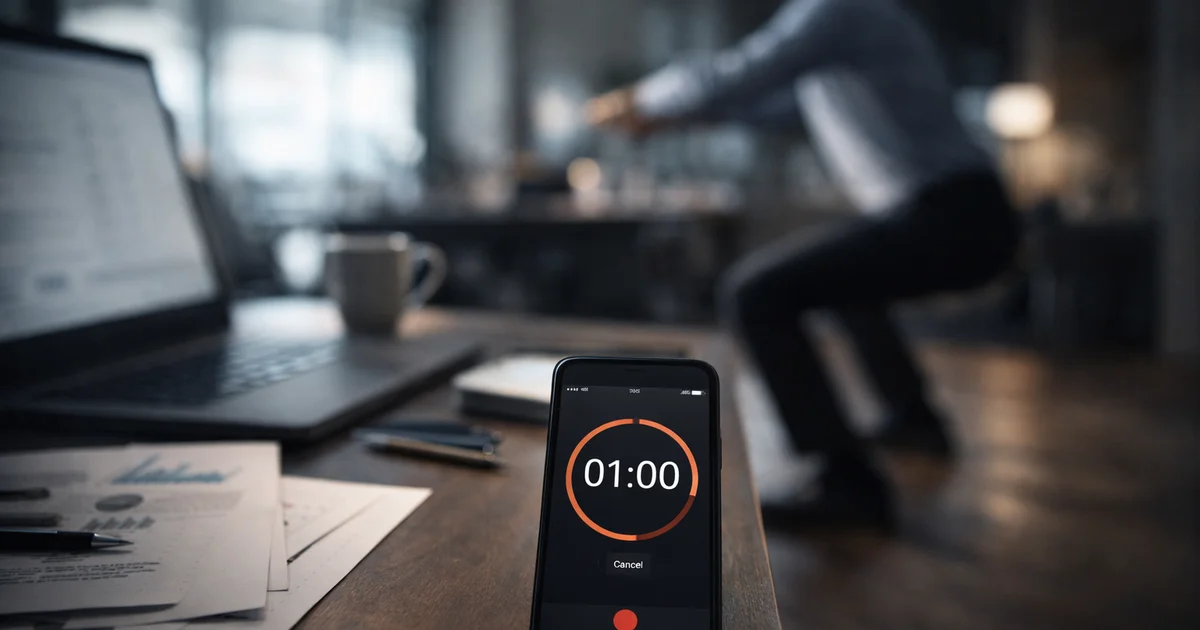
Set a phone timer for every two hours. When it rings, move intensely for 60 seconds. That is the entire protocol.
Your gym membership is not a waste. But the 23 hours between sessions might be costing you more than you think.
Related Reading:
Sources and References
- Frontiers in Cardiovascular Medicine — Meta-analysis of 27 studies (970 participants) found exercise snacks significantly improved VO2max (SMD=0.63), reduced systolic BP (SMD=-0.67), fasting blood glucose (SMD=-0.40), LDL (SMD=-0.30), and total cholesterol (SMD=-0.39).
- Scandinavian Journal of Medicine and Science in Sports — Systematic review of 483 adults across 14 studies found exercise snacks improved VO2max with a large effect size (SMD=1.43, p<0.001), plus significant reductions in total cholesterol and LDL.
- Sports (MDPI) — 25 sedentary office workers doing three 1-minute vigorous exercise bouts daily showed 20.9% improvement in executive function after a single bout and 28.6% cognitive processing improvement after 4 weeks.
- Healthcare (MDPI) — Systematic review of 26 studies (2012-2025) found exercise snacks interrupting prolonged sitting were superior to single 30-minute continuous sessions for glycemic control.
Read about our editorial standards →