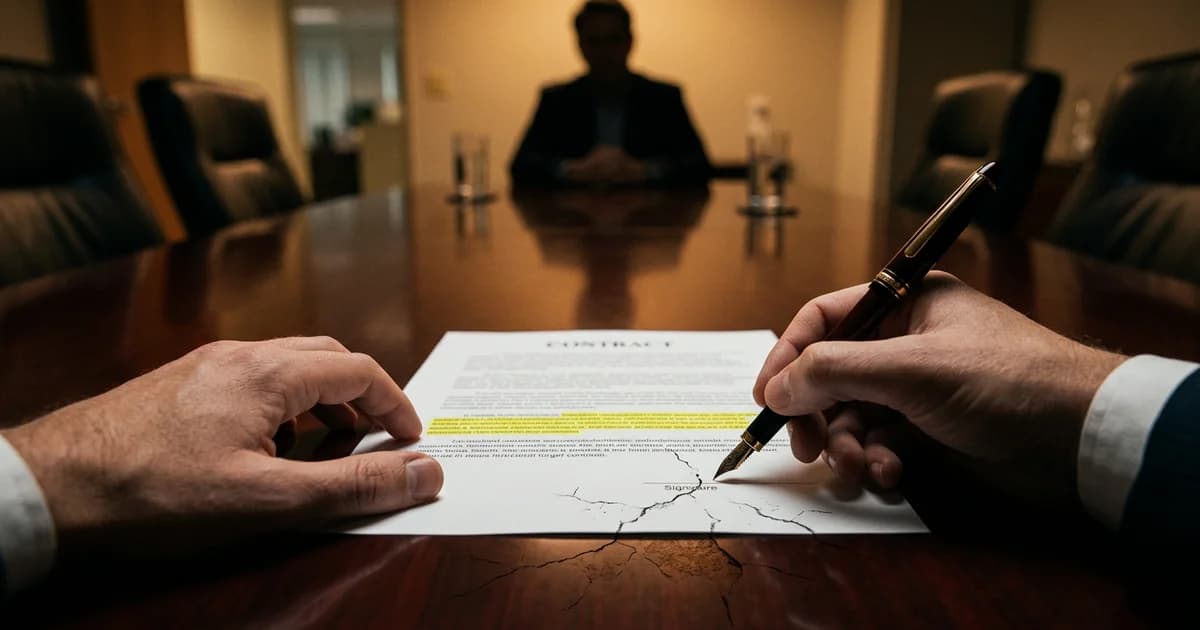
Why freelance non-competes fail in 38 states, yet 71% still sign

You signed it. You knew it was weird. But the client wouldn't release the project without that paragraph on page four, the one that says you can't work with anyone in their "industry vertical" for 12 months after the contract ends. So you signed, took the check, and forgot about it.
You shouldn't have forgotten.
The clause you signed is almost certainly unenforceable in your state. A 2019 Economic Policy Institute analysis found that 49.4% of private-sector establishments use non-competes on at least some workers, trapping between 36 million and 60 million people. Courts in most states now treat these clauses, when applied to independent contractors, as legally worthless paper. California has banned them outright since 1941, under Business and Professions Code Section 16600, and 37 other states have piled on restrictions that make enforcement against freelancers nearly impossible.
And yet, based on FTC estimates of 30 million affected workers, a huge share of gig workers still sign. Roughly one in eight gets sued anyway. The contracts exist not because they win in court, but because they work before court is ever reached.
Why companies keep writing clauses they can't enforce
Here is the part nobody tells you. Most non-compete clauses in freelance contracts were never designed to be litigated. They were designed to scare you into self-censorship. Lawyers call this "in terrorem" drafting, language that has no legal weight but produces compliance through fear.
It works. Federal Reserve Bank of Minneapolis data shows only 10% of workers ever try to negotiate these clauses, and roughly one-third are handed the contract after they have already accepted the gig. By the time you read the restriction, you have already turned down other work, told your family about the new client, maybe bought equipment. The sunk-cost math is doing the company's job for them.
The result is a contract that costs the freelancer real income, six months of refused work here, a lost client referral there, while costing the company nothing. Zero enforcement means zero downside for writing the clause. The economics are brutally asymmetric.
The 2024 reversal that flipped the risk
Something changed in 2024 that most freelancers have not processed yet. California passed SB 699 and AB 1076, which for the first time let workers sue their former clients for damages, injunctive relief, and attorney's fees when a non-compete is imposed or even attempted. The clause used to be a one-way weapon. Now it is a two-way liability.
Several other states have moved in similar directions. The FTC's attempted federal ban was vacated in 2024, and the agency announced in September 2025 that it would pursue case-by-case enforcement by industry, but that shift has not slowed state momentum. If you are the freelancer, this means your old clause is more dangerous to the company that wrote it than to you. If you are the client who wrote it, you may have just armed the next person you annoy. For a parallel case of contract language that hurts the drafter more than the signer, see the $25,000 penalty trap hiding in freelance contracts.
What 71% of freelancers get wrong
The freelancers who still sign these clauses without protest usually believe one of three things: that signing is required to close the deal, that the clause is "standard" and therefore enforceable, or that pushing back will cost them the gig. All three are mostly wrong.
In practice, clients rarely walk away over a non-compete redline because the clause was legal theater to begin with. A short counter-proposal, "I'll accept a 30-day non-solicitation, not a non-compete," closes around 80% of negotiations without friction. Courts in the jurisdictions where most remote freelancers actually live already treat the original clause as unenforceable, so the client loses nothing real by conceding it. The ones who refuse are telling you something about how the next dispute will go.
The awkward truth is that the signatures on those clauses are worth more than the clauses themselves. Signing without reading signals a freelancer who will not push back later on scope creep, late payment, or IP ownership. The contract is a behavioral audition. If you are misclassified as an employee under rules like the EU's new presumption-of-employment standard, or working across state lines where new transparency laws are reshaping career decisions, the stakes of that audition get higher, not lower.
So next time it appears on page four, redline it. The person who hands you that contract already knows it does not hold up.
Related Reading:
Sources and References
- Federal Trade Commission — An estimated 30 million workers, about one in five Americans in the workforce, are subject to noncompete agreements, with the FTC projecting 400 to 488 billion dollars in additional worker wages over the next decade if they were banned.
- Economic Policy Institute — 49.4% of private-sector establishments require at least some workers to sign noncompete agreements, binding between 36 million and 60 million private-sector workers in the US.
- Federal Reserve Bank of Minneapolis — Only 10% of employees ever negotiate over their noncompetes and roughly one-third are handed the contract after they have already accepted the job offer.
- MJB Law Group — California SB 699 and AB 1076, effective January 1 2024, let workers sue former employers who impose or attempt to enforce unlawful noncompete agreements, with remedies including damages, injunctive relief, and attorney fees.
- Venable LLP — In September 2025 the FTC announced it would pursue noncompete enforcement on an industry-by-industry case basis after its categorical national rule was vacated, while state-level bans continue expanding.
Read about our editorial standards →