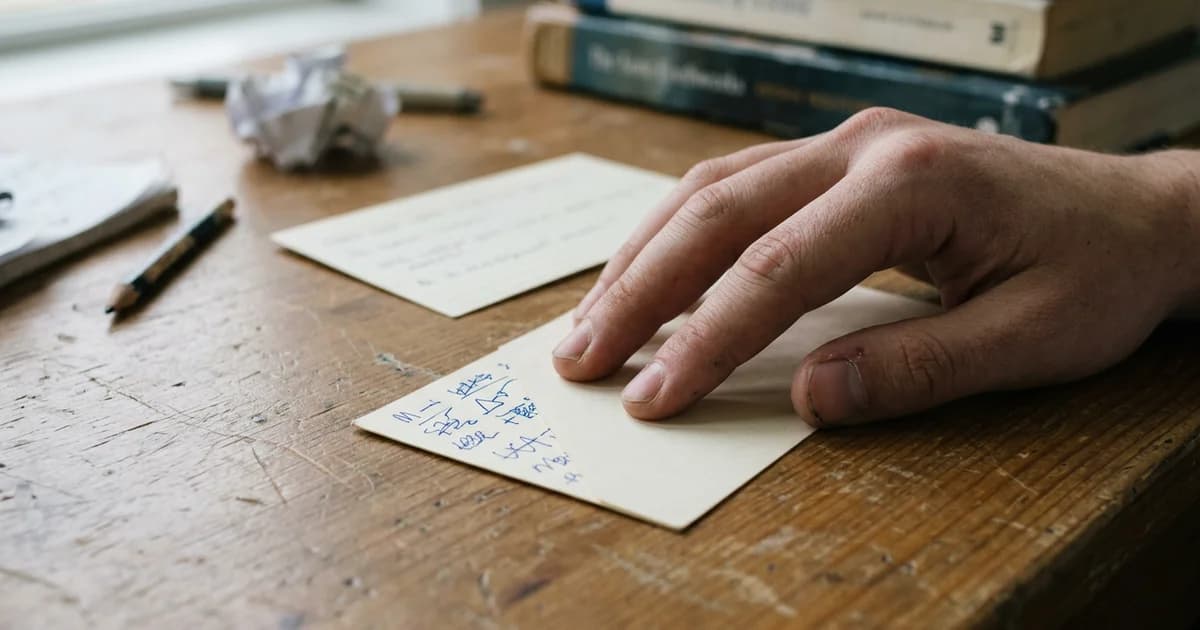
The near-miss flashcard rule that makes recall stick

The best flashcard is not the one you answer instantly. It is the one that makes your brain hover, reach, almost miss, and then land.
That is the shortcut inside retrieval practice: difficulty helps when the answer is related enough to pull from memory, but not so obvious that your brain coasts. An April 2026 paper in npj Science of Learning tested semantic relatedness to clarify when retrieval helps most, and the result upgrades the old advice to "just quiz yourself more."
The rule is sharper: make recall feel like a near miss.
Retrieval practice works when recall has friction
Retrieval practice is usually sold as a binary move. Close the book. Quiz yourself. Repeat. That is better than rereading, but it hides the variable that changes everything: how close the prompt is to the answer.
If the cue is too easy, you are recognizing, not retrieving. If it is too distant, you are guessing, not learning. The productive zone sits between those poles, where the cue activates the right memory neighborhood without handing you the key.
That matters for anyone using Anki, Quizlet, AI tutors, language apps, certification prep, or handwritten cards. The point is to design cards where your brain has enough traction to struggle intelligently.
This is why strong study systems often feel less fluent than they look. In our earlier breakdown of 3 study methods ranked: the winner is the one you avoid, the uncomfortable method won because fluency is a terrible proxy for retention.
The near-miss flashcard beats the obvious one
Here is the simplest test: when you read the front of a card, do you already know the answer category?
A weak card asks, "What is retrieval practice?" It invites a definition. A near-miss card asks, "Why can rereading feel productive while producing weaker delayed recall?" Now the answer has to move through a mechanism: fluency, effort, memory strengthening, feedback.
For vocabulary, the same rule applies. A card that asks for the foreign word after showing an identical translation may be too direct. A better card might use a short sentence, a related synonym, or a confusable context. Then corrective feedback locks the answer in. A June 2026 Brain and Language study found that retrieval practice with corrective feedback improved delayed foreign-vocabulary recall compared with restudying.
The hidden lever is semantic relatedness. You want the prompt close enough to wake up competing memories, because competition forces selection. Selection is the rep.
Gamified studying can hide weak recall
Here is what nobody mentions when apps show streaks, points, and progress bars: motivation is not memory.
A 2026 open-access study in Computers in Human Behavior found that points and progress bars improved motivation but did not improve posttest recall after two to three days. The interface can make studying feel alive while the retrieval demand stays shallow.
Use the metrics, but do not worship them. A streak says you showed up. It does not say whether the cue made your brain retrieve, discriminate, and correct.
If you use AI for learning, this becomes more important. An assistant can make every explanation feel smooth, and smoothness is the trap. The safer pattern is the one we flagged in AI boosted student scores 48%, then crashed them 17%: use the tool to generate tests, not just answers.
Build cards that make your brain choose
Try this three-part filter today.
- If you can answer in under two seconds every time, make the cue less direct.
- If you stare blankly with no route in, add a related hint or example.
- If you got it wrong, write the correction in a way that exposes the confusion, not just the right answer.
For a professional exam, turn isolated facts into scenario prompts. For language learning, mix similar words instead of drilling one neat list. For a dense book, ask why an idea matters, when it fails, and what it is often confused with.
This is where the one mental model that makes all other mental models work becomes useful: reduce the concept to first principles, then rebuild the card around the distinction you need to remember.
The next time a flashcard feels satisfyingly easy, distrust the satisfaction. The card may be training recognition, not memory. Move it one inch closer to confusion, add fast feedback, and let the near miss do the work.
Related Reading:
Sources and References
- npj Science of Learning — An April 2026 npj Science of Learning paper tested semantic relatedness to clarify when retrieval practice helps most, challenging generic advice to simply quiz yourself more.
- Brain and Language — A June 2026 Brain and Language study found retrieval practice with corrective feedback improved delayed recall of foreign vocabulary compared with restudying.
- Computers in Human Behavior — A 2026 open-access study found points and progress bars improved motivation but did not improve posttest recall after two to three days.
Read about our editorial standards →