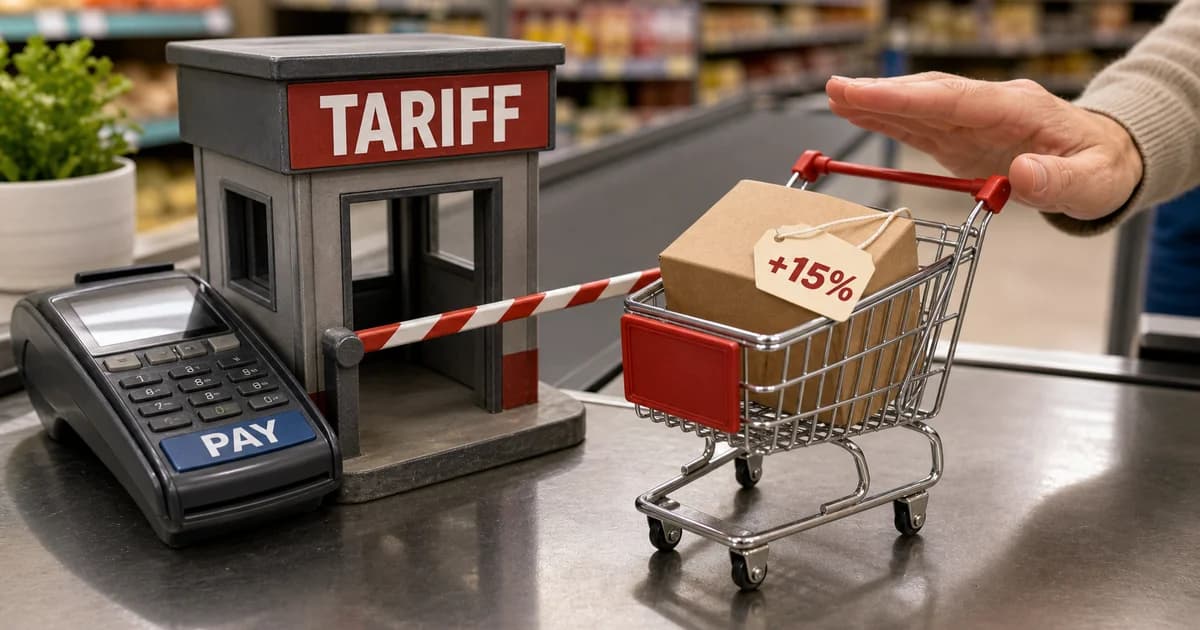
Tariffs Moved From Supply Chains Into Checkout Psychology

For years, tariffs were a distant concept, a line item in a corporate ledger or a topic for policy debates. Today, they are a direct psychological trigger at the digital checkout. The abstract pressure on supply chains has crystallized into a concrete, personal problem: the final price you see before you click "pay." This shift transforms tariffs from a business operational challenge into a potent force shaping consumer trust, purchasing decisions, and brand perception.
Why this matters now
The journey begins with a corporate decision. According to a KPMG 2026 Tariff Survey, 55% of executives are planning additional price increases of up to 15% within the next six months. These are not hypothetical plans; they are active strategies to manage rising import costs. The survey highlights a critical bridge: the corporate response to tariff pressure is a direct precursor to the consumer experience. When a company decides to pass on these costs, the burden moves from the balance sheet to the shopping cart.
The mechanism of this transfer is explained by economic analysis. The Congressional Budget Office (CBO) clarifies that while tariffs are legally paid by importers, the ultimate cost burden "can be passed through to consumers, depending on market conditions." This "depending on" is the crucial variable. In competitive markets, companies may absorb some costs to retain customers. In markets with less competition, or for products with strong brand loyalty, the pass-through can be swift and nearly total. The CBO's framing removes the abstraction: tariffs are not just a tax on companies; they are a potential tax on your purchase, activated by corporate pricing decisions.
The downstream result is captured in the hard data of everyday life. The U.S. Bureau of Labor Statistics (BLS) Consumer Price Index (CPI) is the official scoreboard for this phenomenon. When businesses pass higher input costs from tariffs into final shelf prices, it registers in the CPI. This data is the aggregation of millions of individual checkout moments where a consumer notices a price is higher than it was last month. It's the statistical proof of a psychological event.
What changes in practice
This is where the hidden truth emerges. The real impact of tariffs is no longer measured solely in trade volumes or corporate profit margins. It is measured in the moment of hesitation. When a customer sees a familiar product's price jump at checkout, several psychological hooks are triggered. Recency bias makes the new, higher price starkly noticeable compared to the memory of the last purchase. An identity trigger can occur: "Am I someone who pays this much for this?" Loss aversion kicks in powerfully; the feeling of "losing" money compared to a past price can be stronger than the rational assessment of the product's value. The tariff, now invisible in the process, becomes highly visible in the outcome.
This psychological shift forces businesses to rethink their communication and pricing strategies. A simple price increase can be interpreted as greed or poor management if the tariff context is not understood. Transparency becomes a trust-building tool. Some companies might choose to explain cost pressures, while others might redesign value bundles or loyalty programs to soften the blow. The challenge is akin to other operational hurdles where technology meets human perception, such as when implementing new systems that initially fail to meet user expectations. For instance, understanding why 88% of enterprise AI agents fail before going live often hinges on the gap between technical capability and user experience. Similarly, the success of passing on costs depends not just on the economics, but on managing the customer's psychological response at the point of sale. Companies learn to work with imperfect systems, as seen when AI agents fail 1 in 3 tasks but companies use them anyway for their aggregate benefit.
For consumers, the lesson is to recognize the layers behind a price tag. A price increase may not be arbitrary. It can be the endpoint of a long chain that starts with a policy change, moves through corporate logistics and finance, and finally lands in your online cart. This awareness doesn't necessarily prevent the sting of a higher cost, but it can frame it, reducing the impulse to attribute the increase solely to the retailer. It turns a moment of frustration into a moment of economic literacy.
Ultimately, tariffs have migrated. They've moved from the realm of international relations and supply chain seminars into the psychology of everyday commerce. The final test of a tariff's impact is no longer a government revenue report; it's the split-second decision a consumer makes when the total updates at checkout. Understanding this journey: from policy to corporate strategy to psychological trigger: is key for businesses aiming to maintain trust and for consumers navigating a more expensive landscape.
Sources and References
- KPMG — KPMG’s 2026 Tariff Survey found 55% of executives planning additional price increases of up to 15% within six months.
- Congressional Budget Office — CBO analysis of tariffs emphasizes that tariff costs are paid by importers but can be passed through to consumers, depending on market conditions.
- U.S. Bureau of Labor Statistics — Consumer price data is the downstream scoreboard when businesses pass higher input costs into shelf prices and checkout totals.
Read about our editorial standards →