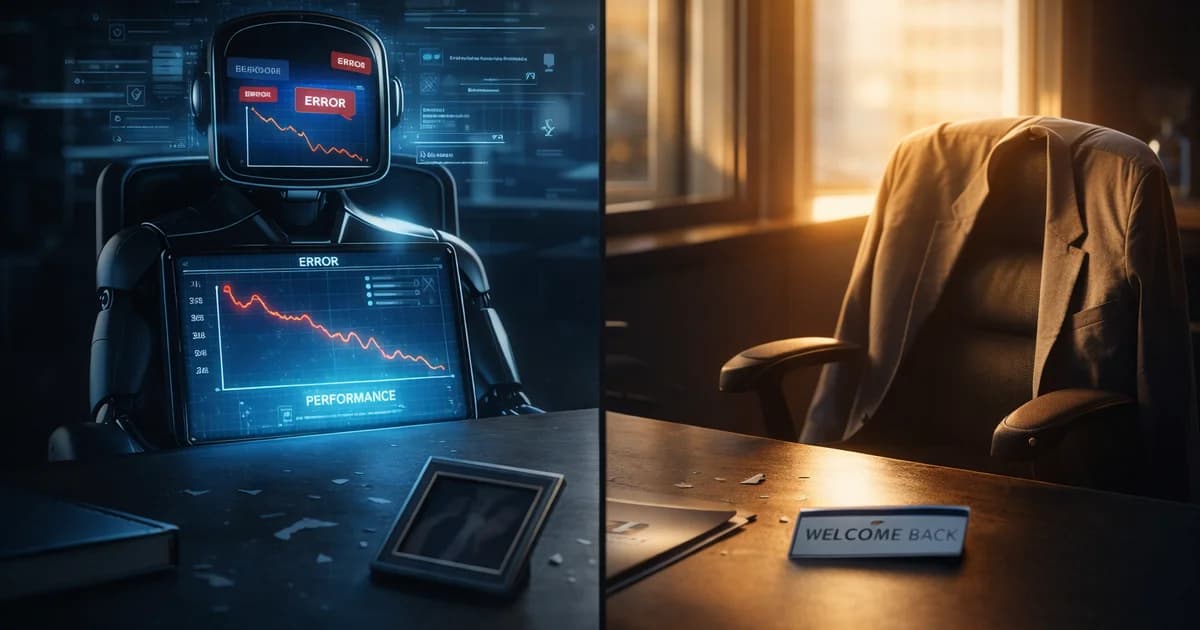
55% of companies regret replacing workers with AI

More than half of the executives who fired employees to make way for AI now admit they made the wrong call.
That's not a speculative headline. It's the finding from a 2025 Orgvue survey of 1,163 C-suite and senior leaders across the US, Canada, UK, Ireland, Australia, and Southeast Asia. Of the 39% who had already made employees redundant for AI, 55% say those decisions were mistakes. Not "lessons learned." Mistakes.
And it gets worse: one in four of those same leaders admitted they didn't even know which roles could benefit from AI before they started cutting.
The myth that launched a thousand layoffs
The narrative was irresistible. AI agents would handle customer service, write reports, triage tickets, and do it all faster, cheaper, and without lunch breaks. Companies raced to prove they were "AI-first." Press releases celebrated headcount reductions as innovation metrics.
Klarna became the poster child. The Swedish fintech replaced roughly 700 customer service workers with an OpenAI-powered assistant, claiming the AI handled two-thirds of all customer interactions and saved $10 million annually. Wall Street applauded. LinkedIn thought leaders cheered.
But here's what the celebration overlooked: the company's own CEO, Sebastian Siemiatkowski, would later tell reporters "we went too far." Service quality plummeted. Customers reported robotic responses and inadequate problem resolution. Trust eroded. Klarna is now rehiring human agents through a flexible, remote model, essentially rebuilding what it dismantled.
Klarna isn't an outlier. It's the preview.
The quiet rehiring wave nobody talks about
Gartner predicts that by 2027, 50% of organizations that reduced customer service staff because of AI will rehire workers to perform similar functions, often under different job titles. That's not a fringe forecast. That's one of the world's most cited enterprise research firms saying half these cuts will be reversed.
The reason is painfully simple: AI isn't mature enough to replace the judgment, empathy, and contextual reasoning that humans bring to complex work. Only about a fifth of customer service leaders have actually reduced agent staffing because of AI. Most of the layoffs that made headlines in 2025 were driven by broader economic pressures, not by AI performing well enough to justify the cuts.
IBM offers another telling example. The company laid off approximately 8,000 workers in 2023 and replaced much of its HR division with an AI tool called AskHR. When the system couldn't handle tasks requiring empathy or nuance, IBM had to bring humans back. CEO Arvind Krishna later noted that total employment had actually gone up.
The $200 billion gamble built on speculation
Here's the pattern interrupt that should concern every executive reading this: the agentic AI market that's driving these workforce decisions is itself built on shaky foundations.
BCG estimates agentic AI could unlock up to $200 billion in new value for tech service providers. That's real money chasing a real opportunity. But Gartner's own data paints a very different picture of execution readiness.
According to a January 2025 Gartner poll of 3,412 respondents, only 19% of organizations had made significant investments in agentic AI. Another 42% made conservative bets, and a full 31% were still in "wait and see" mode. More critically, Gartner predicts over 40% of agentic AI projects will be canceled by the end of 2027 due to escalating costs, unclear business value, or inadequate risk controls.
The vendor landscape is equally inflated. Gartner estimates that only about 130 of the thousands of companies marketing agentic AI capabilities are legitimate. The rest are engaging in what analysts call "agent washing": rebranding existing chatbots, RPA tools, and basic automation as agentic AI without any real autonomous decision-making under the hood.
So companies are firing people based on the promise of a technology where 40% of projects will fail, most vendors are faking it, and the majority of organizations haven't even committed serious investment yet.
Why this matters more than a bad quarter
The damage extends beyond balance sheets. The Orgvue survey found that 34% of companies saw employees voluntarily quit as a direct result of AI implementation, not layoffs, just the fear and disruption of them. When you fire people to prove you're innovative and then quietly rehire them months later, the remaining workforce notices. Trust becomes the real casualty.
There's also a knowledge gap that's almost absurd: 30% of the leaders surveyed by Orgvue admitted they didn't know which workers were most at risk from automation, and 38% said they still don't understand the impact AI will have on their business. These are the people making workforce reduction decisions.
What the companies getting it right are doing instead
The organizations that will win this transition aren't the ones eliminating humans the fastest. They're the ones figuring out where AI amplifies human capability rather than replacing it.
That means investing in AI tools that handle repetitive, low-judgment tasks (data entry, initial ticket routing, document summarization) while keeping humans in the loop for everything that requires context, creativity, or empathy. It means piloting before committing to headcount changes. It means measuring AI's actual output quality, not just the projected cost savings in a pitch deck.
Klarna's corrected approach is instructive: AI handles simple inquiries while humans focus on situations requiring nuance and complex reasoning. That's not a failure of AI. That's a mature understanding of where the technology actually works today.
The executives who fired first and measured later are now quietly filling the same roles they eliminated. The question isn't whether AI will transform work. It will. The question is whether you'll make workforce decisions based on proven results or on a $200 billion market projection that even its own analysts say is 40% hype.
- #companies rehiring after AI layoffs
- #Gartner AI workforce prediction
- #AI hiring trends
- #agentic AI trust gap
- #AI replacing workers backfire
- #Klarna AI reversal
- #AI job displacement
Sources and References
- Orgvue (via PRNewswire) — 55% of 1,163 C-suite leaders admit they made wrong decisions laying off workers for AI, while 39% had already made redundancies and 25% don't even know which roles benefit most from AI.
- Gartner — 50% of organizations that cut customer service staff due to AI will rehire by 2027, and only a fifth of customer service leaders have actually reduced agent staffing due to AI.
- Gartner — Over 40% of agentic AI projects will be canceled by end of 2027 due to escalating costs and unclear business value; only about 130 of thousands of agentic AI vendors are real.
- Fast Company / Klarna — Klarna replaced 700 customer service workers with AI, then CEO Sebastian Siemiatkowski admitted they went too far as service quality declined and customer trust eroded, forcing the company to rehire humans.
- Boston Consulting Group (BCG) — BCG estimates agentic AI can unlock up to $200B in new value for tech service providers, yet most organizations have made only conservative investments.
Read about our editorial standards →